Categories
Papers

Counting the Net: Internet Access Indicators

Michael MINGES <minges@itu.int>
International Telecommunication Union
Switzerland

Abstract

The Internet has had a major impact on society and business during the last decade of the 20th century. Yet, despite the popular interest generated by the Internet, there is a lack of comparable data on its spread across the world. Though the quality and quantity of information has recently improved, there are still wide variations in definitions, comparability and scope. Market analysts, particularly keen on the size of electronic commerce, have generated many recent estimates. This type of information — though it varies widely depending on the source — is increasingly compiled for developed countries. However, there is a shortage of publicly available data on Internet accessibility, particularly for developing countries. Standard indicators and definitions are needed to measure Internet access across countries. This document outlines statistics that are presently being used, as well as their limitations, and proposes a set of harmonized Internet access indicators.

Contents

1. Infrastructure

Infrastructure statistics measure the stock of communication equipment needed for accessing the Internet [1]. This includes Internet host computers and supporting hardware such as telephone lines and personal computers.

1.1 The host dilemma

The most commonly (ab)used indicator to compare Internet development between countries is the number of host computers. The best known survey of Internet hosts is carried out twice a year by Network Wizards for the Internet Software Consortium [2]. Some national Internet network administrators compile data on the number of hosts in their countries [3].

Networks Wizards uses the following definition of hosts: “A host is a domain name that has an IP address (A) record associated with it. This would be any computer system connected to the Internet (via full or part-time, direct or dialup connections). ie. nw.com, www.nw.com.” [4] While hosts might be a useful infrastructure indicator of the number of computers in a nation that are connected to the Internet, it is a poor indicator of accessibility since it does not measure the number of users [5]. Furthermore, the definition of host is vague. What exactly are they? It is easy to conceptualize a Web server that provides access to the Internet or disseminates information or is used as a conduit to sell products and services. Yet hosts also include name servers, mail servers, file servers and other automated devices. They enable the Internet to operate, but are less meaningful in terms of analysis [6]. The measurement of host data is also subject to criticism. For example, a single computer may host several domain names and a single domain name might be hosted by a group of computers. Also, the physical connection to a host may not be operational when the survey is carried out. As a result, the data have been prone to major revisions and there are often anomalies between surveys.

Table 1: Top 10 Internet domain names per capita
Rank Country Population (000s) 1998 Internet Hosts, July 1999
Total % of Population
1 Niue (.nu) 2 6,745 337.3%
2 Finland (.fi) 5,154 577,029 11.2%
3 Iceland (.is) 276 24,729 9.0%
4 Norway (.no) 4,446 335,898 7.6%
5 Sweden (.se) 8,854 515,031 5.8%
6 Denmark (.dk) 5,299 287,273 5.4%
7 Australia (.au) 18,709 907,637 4.9%
8 New Zealand (.nz) 3,899 182,021 4.7%
9 Canada (.ca) 30,300 1,294,447 4.3%
10 Netherlands (.nl) 15,742 637,591 4.1%
Source: ITU adapted from Internet Software Consortium (http://www.isc.org/)

A major drawback with hosts is that they are assumed to be located in the country shown by their two-letter ISO country code Top Level Domain (ccTLD) (e.g., .nl for Netherlands). However, “There is not necessarily any correlation between a host’s domain name and where it is actually located. A host with a .NL domain name could easily be located in the U.S. or any other country. In addition, hosts under domains EDU/ORG/NET/COM/INT could be located anywhere. There is no way to determine where a host is without asking its administrator.” [7] This is a major shortcoming and results in misleading interpretation of the data. For example, the top country in terms of Internet host penetration at July 1999 was the tiny Pacific island of Niue with more than three hosts per inhabitant (see Table 1). Clearly few of those host computers are located in Niue where the number of Internet users was estimated at 200-300 in November 1999 [8]. Another Pacific nation, the Solomon Islands, had no hosts according to the July 1999 Network Wizards survey. Yet that country has had hosts connected to the Internet at least since 1996 [9]. The United States, which is typically assumed to be one of the most Internet-connected countries in the world, only ranks 44th in Internet penetration based on the .us ccTLD. Clearly, the overwhelming number of hosts in the United States are using something other than .us.

As long as Internet host data are based upon the ccTLD name rather than the actual location of the host, they should be interpreted carefully. Although there have been attempts to adjust host counts according to where they are located, these efforts are carried out infrequently or are not widely available [10]. In any case, a more understandable indicator than hosts would be the number of organizations with an Internet site in the country. For example, a study of the largest 1,000 firms in Singapore found that 46 percent had their own website [11]. This analysis could be extended to the number of governmental, educational, and other establishments with websites [12].

1.2 Telephones and personal computers

Telephone lines and personal computers are key components for Internet access. Both have significant impact on the take-up of Internet in a country. Dial-up Internet access requires a telephone line and a personal computer (with a modem). These hardware components thus constitute an upper limit for Internet access. For example, if 25 percent of households have personal computers with modems, then Internet access from households cannot exceed 25 percent. Pro-Internet policies will not be successful if they do not address these fundamental access requirements.

The International Telecommunication Union (ITU) compiles both telephone line and personal computer statistics [13]. Telephone lines for a country include telephone subscribers plus the number of pay phones. These data are regularly supplied by telecommunication authorities or operators. Personal computer data require more effort to compile. Though estimates are generally available for developed countries, they are usually compiled by market researchers and available only for a relatively high price. Most of the ITU data are compiled by estimating the stock of personal computers from sales or import data. This is problematic for many developing countries where shipment data are scarce and a significant portion of imported personal computers can evade statistical reporting (e.g., smuggling, gray market, local assembly). It is useful to disaggregate telephone line and personal computer data by households and business to obtain a more insightful analysis.

2. Access

This group of indicators measures access to the Internet. It is critical to distinguish between different aspects of access. The indicators in this category are often used interchangeably, making comparisons difficult. However, there are key distinctions that should be observed. One way is to start with the total potential Internet universe and gradually burrow into deeper layers. The outer shell is the number of inhabitants in the country. This figure is the total potential Internet universe and is necessary for deriving penetration figures. Most market research limits the data to the adult population, which can affect comparability and often ignore a significant portion of users. The next layer is the number of people that are aware of the Internet. People who do not know about the Internet are not going to use it. The next critical statistic is those covered by the Internet — that is, the number of people within easy access of the Internet regardless of whether they are using it. After that is the number of users. The frequency and sophistication of use are important qualifiers. Finally, at the core are the number of subscribers, those paying for access to the Internet. This is the most verifiable statistic, but not necessarily a good measure of usage because most users do not themselves pay directly for access [14].

2.1 Users

Table 2: Internet users in Western Europe
Country (000s) Date As % of Population Sample Age Source
Spain 2,830 Nov-99 7.2% 14+ AUI
France (a) 5,660 Nov-99 9.5% 15+ Médiangles
Austria 858 Sep-99 10.5% 14+ ORF
Ireland (b) 444 Oct-99 12.1% adults Amárach
UK 12,500 Oct-99 21.2% 16+ CommerceNet
Finland (c) 1,964 Nov-99 38.1% 15-74 TOY
Sweden 3,630 Nov-99 41.0% 12-79 SIFO
Note: (a) 6.3 million including public access points (e.g., cybercafes) and access from friends’ houses. (b) “Regular” users. (c) “Sometimes used Internet.”
Source: ITU adapted from sources shown.

The number of users is a basic and seemingly comprehensible measure of Internet access. However, comparisons of user data are misleading because there is no standard definition of frequency (e.g., daily, weekly, monthly) or services used (e.g., e-mail, World Wide Web). Although there are several well-known sources of Internet users for different countries, they are often collected from various national surveys that are not comparable [15] and typically ignore developing countries completely [16]. The commercialization of the Internet and increasing interest in electronic commerce has resulted in a growing number of market researchers collecting national user statistics [17]. These are typically based on sample surveys projected for the population as a whole. Table 2 shows the results of user surveys now available for about half the countries in Western Europe. Plans by experienced market research firms to conduct Internet surveys in a number of countries could enhance availability and comparability [18]. One danger is that since these surveys are carried out by private firms, much of the data will remain restricted to clients or be prohibitively expensive for widespread analysis. Also, such “snapshot” surveys are often not repeated on a systematic basis, restricting the analysis of trends over time. Growing involvement of national statistical agencies in compiling Internet user data will help to make such data more widely available to the public. The Australian Bureau of Statistics compiles estimates on the number of Internet users for that country based on household surveys [19]. The U.S. Census Bureau has also started to compile Internet usage statistics derived from its Current Population Surveys [20].

2.2 Subscribers

The number of Internet subscribers — those paying for access to the Internet — is a more precise indicator of access than users. Subscription suggests a certain intensity of use since it is unlikely one would be paying for Internet access unless it is being utilized regularly. It should be noted that the number of subscribers measures those who are paying for a subscription and not the number of users. Many users obtain access for free either as the member of a household, or from work or school. On the other hand, the number of subscribers is useful for estimating the number of users when user data are unavailable. The number of subscribers thus sets a minimum threshold for the number of users in a country. Data about the nature of the subscription such as paid or free, business or consumer, and the access method (dial-up, leased line, cable modem, or broadband telephone line (ISDN, xDSL)) also are useful.

Table 3: Internet subscribers
Country Subscribers Per 100 inhabitants Source
Singapore 394,000 12.45 Statistics Singapore. National statistical agency.
Hong Kong 616,436 9.22 OFTA.
Telecom regulator.
Belgium 302,435 2.98 Belgium ISP Association.
8 major providers.
UAE 66,725 2.84 Etisalat. ISP.
Sole provider.
Venezuela 166,000 0.71 CANTV. ISP. Based on CANTV market share.
Note: All data at December 1998 except Belgium (3/99).
Source: ITU, adapted from sources shown.

Many Internet service providers (ISPs) report their subscriber counts. In countries where ISP service is not a monopoly, individual ISP data needs to be aggregated to obtain a national total. If not all ISPs report, country-level data may be hard to obtain. Also, some ISPs originated as on-line providers to their own proprietary content. Some subscribers may still be accessing only the provider’s content and thus not truly be Internet users. Some ISPs report their market share which allows a country-level statistic to be derived. Some national ISP organizations also report the total number of subscribers for the country [21]. A number of government agencies, typically communication regulators but also increasingly national statistical agencies, are compiling country-level subscriber data. The latter typically focus on household subscribership. Examples of Internet subscriber data from different sources are shown in Table 3.

2.3 Coverage

An ideal indicator would be a coverage statistic — that is, the portion of the population of a country within easy access of the Internet, whether they use it or not. This indicator would express the potential Internet user market and is the fundamental measure of universal access to the Internet. High coverage would denote a significant policy achievement in that technically, people can access the Internet even though they may choose not to do so for other reasons (e.g., high cost, lack of interest). One problem is that few organizations measure those who have access to the Internet. When this is done, it is often confusing, with the term “access” often used synonymously with “user.” Surveys also generally ask if access to the Internet is from home, work or school and ignore public access points such as cybercafes. It would be useful to have statistics on the number of community locations with Internet access. Another challenge is the definition of “easy” access. Practically every country today has a cybercafe where theoretically any inhabitant could walk in and access. Obviously the utility of this is influenced by the distance of the potential user from the place of Internet access. Thus a very useful indicator would be distance from Internet access measured in time or length (e.g., minutes to reach or kilometers from an access point).

Data from the few surveys that do distinguish between having access to the Internet and using the Internet are shown in Figure 1. Another measure of potential Internet accessibility would be the number of households with both a telephone line and a personal computer, the basic requirements for home Internet access [22]. This indicator is analogous to what is used to define universal service for telephones and could have the same application for the Internet.


Figure 1

With all the publicity surrounding the Internet, it is hard to believe that there are people that do not know about it. Yet awareness of the Internet is far from universal. For example, in the United Kingdom, some 1.6 million adults had not heard of the Internet according to a September 1999 survey [23]. This type of indicator is important since those who do not know about the Internet are not going to use it. It is also useful to provide a breakdown of awareness as shown in Figure 2.


Figure 2

3. Policy

Some indicators are related to access and thus analytically important from a policy perspective. For example, a competitive ISP market should theoretically put pressure on pricing and thus enhance accessibility. Tariffs have a strong impact on accessibility while the amount of use reflects the intensity of access.

3.1 ISPs

Some argue that competitive ISP markets tend to reduce usage prices, enhance availability of different services and improve quality, all of which impact access. The number of ISPs in a country is often taken to be an index of market liberalization. One problem with counting the number of ISPs is that in many countries, there is no legal requirement for them to register. That, combined with the fact that barriers to entry are relatively low, makes an accurate count of ISPs difficult in large, liberalized markets. In countries where ISPs must register, a distinction should be made between “licensed” and ISPs actually in operation. ISP associations in several countries report the number of members, but the figures may not include all providers. Some government authorities keep track of the number of ISPs. For example, in Hong Kong, the telecommunication regulator has a time series on the number of licensed ISPs (see Figure 3).
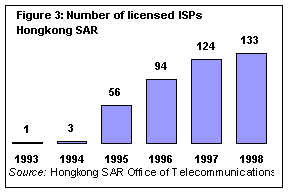

Figure 3

3.2 Tariffs

Tariffs are an important indicator of accessibility since if people cannot afford the Internet they will not use it. They may also reveal why some countries have a high level of potential Internet access (e.g., high levels of telephone lines and personal computers) but low user levels. Internet tariff comparisons are complex for a number of reasons. First, there are different prices depending on the access infrastructure (e.g., dial-up telephone line, leased line, cable television, mobile phone). Second, there can be a variety of different prices both across and within service providers (e.g., depending on time of day, hours of use). Third, in competitive markets, prices can change rapidly. From a policy viewpoint the most significant Internet tariffs are those associated with dial-up telephone access since this is the most heavily used method of Internet access by individuals at the present time.

Dial-up Internet tariffs consist of two components: (1) telephone usage charges (monthly subscription (line rental) and call charge paid to the telephone company), and (2) Internet access charges (paid to the ISP). There are a variety of issues to consider. One has to do with local call charges. Some telephone operators do not charge directly on a usage basis for local calls. This is usually based on historical reasons and includes most operators in North America and New Zealand. Other operators include a certain number of local calls in the subscription charge; after these “free” calls have been used up, users pay for each call. Some operators charge a one-time amount regardless of the length of the call. Some operators have different local call charges depending on the time of day or day of the week or whether the call is for Internet access or provide discounted calls to certain user-specified numbers. In some countries, a nationwide dialing prefix has been assigned to ISPs so all calls are treated as local. ISP charges also vary from no charge to different charges depending on the volume of use, day of week or time of day.

It is useful to compare Internet access prices within and between countries. Figure 4 compares the price of 20 hours off-peak Internet access for several countries. The Organization for Economic Cooperation and Development (OECD) does this for its member countries [24]. There are also a number of national studies on Internet pricing [25].
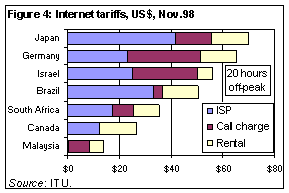

Figure 4

3.3 Traffic

Internet traffic measures usage, an important aspect of Internet access in a country. From a policy perspective, it is interesting to know how long users are spending on the Internet and comparing this over time and between countries. Low usage time might reflect affordability issues or lack of sophistication of use. Two problems with traffic indicators are data and concept. Most operators do not report Internet traffic and few government agencies compile this data. In terms of concept, what should be measured? Is the volume of data transferred across the Internet important or the user session time? From an access perspective, the latter is more relevant. For user connection time, however, there is the additional complexity of whether it is over the fixed telephone network, leased circuit or other means such as cable television or mobile telephone networks.

When available, Internet traffic data are compiled by telecom operators, ISPs, and some government agencies. Deutsche Telekom, the incumbent telecom operator in Germany, provides data on the volume of connection time in minutes over the telephone network to its T-Online service. America Online, the largest ISP in the world measured by the number of subscribers, provides data on the average daily usage in minutes of its subscribers. The Office of Telecommunications in Hong Kong provides statistics on the total number of minutes spent on dial-up access to the Internet each month. Data from these sources reflect wide variations in average usage times (Figure 5).
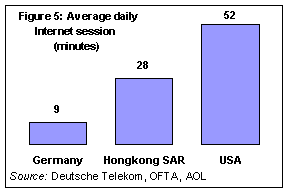

Figure 5

4. The way ahead

This document has outlined a modest but standard list of Internet access indicators to enhance country comparability and assist analysis and policy-making (see Table 4). Examples are provided to illustrate these statistics are presently being compiled in some countries. Most Internet data are amassed by various organizations, difficult to locate, often expensive and frequently available only in national languages. While many governments in the world take an active interest in promoting the Internet, they need to be more involved in collecting, compiling and disseminating Internet-related information in order to evaluate the situation in their country. This would improve availability, enhance standardization, and make information more widely available to the public. Furthermore, while this paper has concentrated on country-level indicators, governments also need to have disaggregated data to identify bottlenecks and minimize “digital divides.” [26] As countries are at different stages of development, governments also need to have statistics that are relevant to their situation. This is often not the case with data compiled by market researchers.

The logical choices for collecting the data are the national statistical office and the communications authority. The national statistical agency focus would be on the user side (e.g., statistics on household ownership and access to Information and Communication Technology) while the communication authority would be on the supplier side (e.g., statistics on number of ISPs, number of subscribers). The national statistical office already has the statistical skills and generally carries out regular household surveys. Internet-related information could easily be added to the survey questionnaires. As industry regulator, the communication authority should gather infrastructure and subscriber statistics, tariffs and other related information.

Until the necessary systems can be put in place, an interim solution is for a government agency to be responsible for locating and disseminating the information on a national Internet monitoring website. When necessary, an English version could also be made available to ease access to the statistics by the international Internet research community as well as potential investors in the market. This “one-stop” shop [27] would enrich analysis [28] and policymaking by making it easier to retrieve data. Quality and transparency would improve by having the data exposed to a larger group of users. One example is the Research on Internet in Slovenia project, coordinated by the University of Ljubljana, which provides a wide variety of useful Internet-related statistics for that country on its website [29]. Another example was a European Union project that compiled Information Technology statistics for its member countries using a standard format [30]. The theme of ISOC ’99 was “Internet is for Everyone.” Standard and timely “Internet Statistics for Everyone” would help measure progress toward that goal.

Table 4: Internet access indicators
Category Indicator Sub-Indicators Definition
INFRASTRUCTURE Internet hosts By 2nd-level domain (e.g., .com, .edu, .gov) A host is a domain name that has an IP address (A) record associated with it. This would be any computer system connected to the Internet (via full- or part-time, direct or dialup connections). ie. nw.com, www.nw.com — Internet Software Consortium.
Telephone lines Residential, business, public Telephone lines connecting a customer’s equipment (e.g., telephone set, facsimile machine, modem) to the Public Switched Telephone Network (PSTN) and which have a dedicated port on a telephone exchange.
Personal computers Households, business Number of computers designed for single person use (though they may be used by many users and/or run unattended).
ACCESS Internet subscribers 1. Dial-up, leased line, other (e.g., cable TV)
2. Residential, business, academic
The number of persons and organizations paying for access to the Internet.
Internet users 1. By frequency: Daily, weekly, monthly
2. By category: Residential, business, academic
The number of persons using the Internet. The methodology should be specified (e.g., frequency and ages).
Access to Internet Number of inhabitants that have access to the Internet (at home, work or school) but who may not necessarily use it.
Awareness of Internet Number of inhabitants that are aware of the Internet.
POLICY Internet Service Providers (ISPs) Number of companies that provide end-user access to the Internet. When necessary, a distinction should be made between “licensed” and “operational” ISPs.
Tariffs 1. Telephone charges (monthly subscription and peak/off-peak local call charge)
2. Internet charges (monthly and peak/off-peak access charges)
Tariffs refer to the prices charged to end users for communication services. Telephone monthly subscription refers to the recurring fixed charge for subscribing to the PSTN. This indicator is not always comparable since some countries include a number of free local calls in the subscription. When subscription charges are reported annually or bi-monthly, they are converted to their corresponding monthly amount. Local call refers to the cost of a one-hour call within the same exchange area using the subscriber’s equipment (i.e., not from a public telephone). The price for peak and off-peak calls should be specified separately. If there is a different telephone tariff for Internet access, this should be noted.
The values for Internet access should be specified: monthly subscription and peak/off-peak per hour charges. If a certain number of hours is included or Internet access is free, this should be specified.
Tariffs can be classified by access technology: normal telephone line, ISDN, xDSL, WLL, cable television, mobile cellular and dial-up or leased-line.
The treatment of taxes should be specified (included or not, not applicable, etc.).
Dial-up Internet Traffic The volume of Internet dial-up traffic in minutes.
Note: These data should be collected at least on an annual basis but preferably quarterly.
Source: International Telecommunication Union.

Acknowledgments and disclaimer

Tim Kelly and Larry Press provided valuable comments. The views expressed are those of the author and may not represent those of the ITU or its members.

References

[1] For another perspective on infrastructure indicators see Organization for Economic Cooperation and Development (OECD). Internet Infrastructure Indicators. October 1998. Paris. Available at <http://www.oecd.org/dsti/sti/it/cm/prod/tisp98-7e.htm>.

[2] The surveys are available on the Internet Software Consortium website at <http://www.isc.org/ds/. Réseaux IP Européens (RIPE) conducts monthly surveys of European host computers (as well as some countries in Asia and North Africa). The surveys are available on the RIPE website at <http://www.ripe.net/>.

[3] For example, the Korea Network Information Centre (KNRIC) compiles a variety of Internet statistics including hosts for the Republic of Korea. See the KRNIC website at: <http://www.krnic.net/english/net/2_93_00.html>.

[4] See http://www.isc.org/ds/defs.html which also provides definitions of other terms.

[5] The number of users has often been estimated based on the number of hosts. For example, “Such guesses are based on counting the number of computers connected to the Internet, guessing how many people use each computer, multiplying the two…” See Peter H. Lewis. “The Internet and Gender.” New York Times. 29 May 1995. Available at <http://www.mids.org/nytgen.html>. However, this practice is unreliable as the number of users per host varies widely among countries. Nonetheless there is typically a relationship between the number of users and hosts.

[6] For example, Netcraft collects data on the number of Internet hosts providing Web (http) services. It found there were 6.6 million Web servers in July 1999 compared to a global host count reported by the Internet Software Consortium of 56.2 million. It makes one wonder what the other some 50 million hosts are doing. See the Netcraft Web Server Survey at <http://www.netcraft.com/survey/>.

[7] See <http://www.isc.org/ds/faq.html>.

[8] All of whom are provided with free Internet access. See Richard Saint Clair. Full Internet in Niue (NU). E-mail message. 16 November 1999. Available at < http://www.nsrc.org/db/lookup/operation=lookup-report/ID=942799095332:488918744/fromPage=NU >. One reason for the popularity of the .nu domain name is that it is marketed as an alternative to the popular .com. See .NU Domain Ltd. Surge in .NU Domain Registrations Funds A Tiny Nation’s Free Internet Services. Press Release. 3 February 1999. Available at <http://www.nunames.nu/Press/surge.cfm>.

[9] See New IP Hosts SB – Solomon Islands. Available at < http://www.nsrc.org/db/lookup/operation=lookup-report/ID=890202505692:497423945/fromPage=SB >

[10] For example, the OECD mapped host registrations to countries under the generic .com name. In the case of Canada, it found there were over 70 percent more hosts than those represented by the Canadian .ca country domain name. See OECD. Internet Traffic Exchange: Developments and Policy. 1998. Available at: <http://www.oecd.org/dsti/sti/it/cm/prod/traffic.htm>.

[11] See  James Wong &   Eric Lam.  Measuring E-Commerce in Singapore – Methodological Issues and Survey Findings. Singapore Department of Statistics. December 1999. <http://www.singstat.gov.sg/EC/papers/D5.pdf>.

[12] The Netcraft Secure Server Survey gives an indication of the number of websites conducting electronic commerce. The location is derived from the address in the certificate rather than the domain name. See <http://www.netcraft.com/ssl>.

[13] These data are compiled on an annual basis. See http://www.itu.int/ti/.

[14] Numerous user surveys confirm that most users outside of the United States do not pay for access themselves. For example see GVU’s WWW User Surveys at <http://www.gvu.gatech.edu/user_surveys/survey-1998-10/graphs/general/q23.htm >.

[15] One popular online source of the number of Internet users is provided by the Irish company NUA. Although it defines user as “adults and children who have accessed the Internet at least once during the 3 months prior to being surveyed” the national surveys it cites do not always use that methodology. If only subscriber data is available, NUA multiplies this by three to estimate the number of Internet users. See their website at <www.nua.ie>.

[16] Data on Internet users in Africa and the Middle East are being compiled. Mike Jensen has tried to overcome the lack of Internet user statistics for Africa by regularly estimating data for that region. See his website at <http://www3.sn.apc.org/africa/afrmain.htm#user-pops>. User data for the Arab world, derived from subscriber statistics, are available at <http://www.ditnet.co.ae/itnews/me_internet/users.html>. A similar compilation of Internet data for other regions such as Asia or Latin America is sorely lacking.

[17] For example in Finland, Taloustutkimus Oy (http://www.toy.fi/tuotteet/internet/inet5e.htm) has been providing a breakdown of the number of Internet users in that country since 1995. The intensity of use is measured (e.g., every three months, weekly, daily) as well as the location (home, work, school).

[18] One of the world’s leading market researchers, ACNielsen, plans to extend its Internet surveys from North America to more than 30 countries representing about 90 percent of the world’s Internet audience by the end of 2001. See ACNielsen. “ACNielsen, NetRatings Launch First Global Service for Measuring the Internet. ” News Release. 15 November 1999. Available at <http://acnielsen.com/news/asiapacific/sg/19991115.htm>.

[19] An estimated 5.6 million Australian adults (41percent of the adult population) accessed the Internet in the year ending August 1999. See Australian Bureau of Statistics. Use of the Internet by Householders, Australia. ABS Catalogue No. 8147.0. August 1999. http://www.abs.gov.au/websitedbs/D3110122.NSF/66b4effdf36063e24a25648300177cd5/4bb5280f4d9b96694a2567a00005636c?OpenDocument

[20] For example, 22.6 percent of the population between ages of 3-17 and 22.1 percent of the population older than 18 used the Internet in 1997. Although the data are richly disaggregated by location of use, gender, age, region, income and other variables, they are irregularly issued and not up to date. See U.S. Department of Commerce. “Computer Use Up Sharply; One in Five Americans uses Internet, Census Bureau Says.” Press Release CB99-194. Washington D.C. 14 October 1999. <http://www.census.gov/population/www/socdemo/computer.html>.

[21] For example see Belgian Internet Service Providers Association. ISPA market survey gives the update of the Belgian Internet market. 17 September 1999. <http://www.ispa.be/en/c030213.html >.

[22] “The obligations set out in the Voice Telephony Directive comprise the provision of voice telephony service via a fixed connection which will also allow a fax and a modem to operate…By including network access within the scope of universal service, users are given the possibility of accessing not only the defined voice telephony service but all services that can be provided over today’s telecommunications networks (i.e., every citizen will be able to access interactive and on-line information services including the Internet, provided they have a computer and a subscription with an Internet service provider.” http://www.ispo.cec.be/infosoc/legreg/9673.html#RTFToC4

[23] See CommerceNet/Nielsen. “Ecommerce survey shows 27 percent of British adults now use the Internet on a regular basis.” Press Release. London, October 27, 1999. <http://www.q4.com/cnet.objects/Templates/pr/pr271099.html >.

[24] See OECD Internet Access Price Comparison at <http://www.oecd.org/dsti/sti/it/cm/stats/isp-price99.htm >.

[25] Not surprisingly, national studies often refute international comparisons. For example, France and Portugal have been shown to have relatively high Internet access prices in international comparisons. Yet studies carried out by those countries suggest they have  lower Internet access prices than comparable countries. This reflects the difficulty of making meaningful Internet tariff comparisons. See Institut de l’audiovisuel et des télécommunications en Europe – Idate. Le coût de la connection à Internet: comparaison entre quelques grands pays. October 1997.  <http://www.telecom.gouv.fr/francais/activ/techno/technweb1ia.htm> and Instituto das Comunicações de Portugal. Custos de Acesso à Internet em Portugal 1998.  <http://www.icp.pt/publicacoes/estudos/internet/index.html>.

[26] A U.S. government report disaggregates Internet access data by age, sex, income, race and region. See U.S. Department of Commerce. Falling Through the Net: Defining the Digital Divide. July 1999.   <http://www.ntia.doc.gov/ntiahome/digitaldivide >.

[27] An example of this “one-stop” shop for economic statistics is the International Monetary Fund’s  (IMF) Special Data Dissemination Standard (SDDS). The IMF’s SDDS website provides standardized and up-to-date economic and financial data for participating countries in order to enhance transparency and comparability. See <http://dsbb.imf.org>.

[28] This document has focused on the  indicators useful for analyzing Internet development. For an example of the type of analysis that uses these indicators see  “Tracking the Global Diffusion of the Internet” website at http://som.csudh.edu/fac/lpress/gdiff/index.htm.

[29] See “Overview of Basic ICT Indicators in Slovenia” at <http://www.ris.org/ict.html>.

[30] See “Basic Indicators” at <http://www.ispo.cec.be/esis/Basic/HomeBasic.htm>.

Copyright 2000 Michael Minges
Categories
Papers

Domain Name Conflict Resolution Under the .CL Top-Level Domain

José Miguel PIQUER <jose.piquer@dcc.uchile.cl>
Patricio V. POBLETE <ppoblete@dcc.uchile.cl>
University of Chile
Chile

Abstract

For over a year, the .CL top-level domain has been operating under a set of rules that allows for the resolution of conflicts for domain names by an arbitration system. These rules have been very successful in solving the conflicts that have occurred, and also in preventing others, as the mere existence of this system appears to have discouraged many would-be name pirates. Even though the process includes a 30-day publication period, the activation of new names is not significantly delayed, and the system is largely transparent for bona fide applicants.

Contents

Introduction

Since 1986, the Department of Computer Science of the University of Chile has been in charge of handling domain name registrations under the .CL top-level domain. (Our experience in the early days of the Internet in Chile has been published [1].)

For nearly a decade, the process of handling domain name applications ran on an informal basis, without written rules or conflicts. We basically followed RFC 1591 [2] (after it was published), tried to be fair, and hoped that everyone would act in good faith. The smooth operation of the .CL name registry earned it a reputation of being efficient and reliable. Also, while more and more registries started charging for their services, registrations under .CL remained free.

However, in early 1997, it was already apparent to everybody involved in the administration of the registry, and to many members of the community, that it was not feasible to keep providing a free service forever. All the resources used by the registry were provided by the University of Chile, which was reasonable when the technology was unknown to the general public and used mostly by universities. As the number of registrations grew, however, and most of them started coming from commercial entities, it became increasingly difficult to argue that the University of Chile should continue to subsidize this indefinitely.

It was also clear that we had been lucky in avoiding conflicts so far, but it was inevitable that they would happen sooner or later.

These considerations led us to gather a group of volunteers, including several lawyers specializing in intellectual property and the Internet, to write a draft policy that would be a sound basis for domain name registrations. This policy would include a mechanism to resolve disputes and would be our first explicit set of rules. This draft underwent several revisions in the first half of the year, and we had meetings with some ISPs to ask for their input on this matter.

While this process was going on, it was significantly influenced by two events. The first was the beginning of a race between two companies to register as many generic names as they could (e.g., “restaurants.cl,” “travel.cl,” and so on) in the hope of using them to create an index analogous to the “Yellow Pages” of the telephone world, using the Domain Name System (DNS) to implement it. This obvious misuse of the DNS was possible because it cost them nothing to register hundreds of domain names.

Disturbing as it was, this phenomenon further convinced people that some form of charging system was necessary. To socialize this problem, we started publishing the applications on our Web page (http://www.nic.cl) as they were received — in effect, making the public our “in” queue. Fortunately, as the names requested were generic and not brand names, the implications from the point of view of intellectual property were not significant.

The second event happened shortly thereafter and consisted again of two companies (different from the previous two) racing to grab several hundred well-known names, including the proverbial “cocacola.cl”.

In a few days, the public listing on our Web page alerted the press and the business community, and the commotion that followed brought for the first time in Chile the DNS and the Internet to the front page of the national newspapers.

As soon as the media began reporting on this, we started feeling the pressure from the companies that felt themselves victims in this situation. Many of them, for whom the Internet was still a mystery, RFC 1591 notwithstanding, blamed the University of Chile for allowing this to happen. Several of these companies complained to the Rector of the University, who demanded an explanation from us. Those who complained announced their intention of taking legal actions against the University. Representatives from another company went even further and filed suit against both the applicant and the University of Chile, claiming that their constitutional rights had been violated; their point was that by simply allowing an application to be filed for “their” domain name, and not rejecting it outright, we had violated their property rights for that name.

After considering several options, we decided that the new policy should go into effect immediately and that all applications, including those still in the queue, should comply with it. We shut down the service for one working day (a Monday), having worked nonstop through the previous weekend to revise and publish the draft policy and change our systems accordingly. On Monday evening, we were able to begin accepting applications again, with a new Web page, a new registration form with the scripts to process it, and a procedure for charging for registrations.

Before long, normality had returned to the process, and the many parties that considered themselves victims of attempted name piracy were able to make use of the provisions of the policy to defend their rights.

We will describe next the basic ideas in the current policy and how it differs from the one that was introduced then. We will also present some statistics to evaluate the results of its application.

The registration policy

The policy is based on making all the information available to all parties, allowing them a reasonable time so that they can react to applications that they believe may threaten their rights on some name, plus an arbitration system to adjudicate domain names.

To do this, applications are published automatically in our Web page and are listed there for 30 days. During that period, the applicant has to submit (by fax) a signed statement declaring that he or she knows the policy and accepts it. We also require faxed copies of documents attesting the existence and identity of the applicant in Chile (tax ID for companies, personal ID for individuals). Also, during that 30-day period, the applicant must pay the registration fee.

To introduce a minimal delay on the technical functioning of a newly created domain name, we activate new domain names as soon as the faxed papers are received, often on the same day the domain was requested. Officially, this activation is on a trial basis, contingent on the fulfillment of the payment and identification requirements. This way, applicants may start using their domains right away, and in a large majority of the cases, keep using them with no interruptions from then on.

In the case of domain name conflicts, the policy allows for other, competing, applications to be filed during the 30-day publication period. A second applicant for a domain name has to fulfill all the requirements as the first applicant, but of course, the trial activation is not available in this case.

After each applicant has had 30 days to comply with all requirements, those that have failed to meet them (e.g., by not paying) are rejected. Afterwards, if there are no opposing applications, the domain is adjudicated to its only applicant. If there are two or more valid applications, an arbitration process begins. First, the two parties are allowed 10 working days to agree on the name of an arbiter of their choice. Failing that, the NIC appoints an arbiter, chosen in a round-robin fashion from a list. The arbiter first tries to help the parties reach an agreement, and if that is not possible, the arbiter hears the arguments from each side and makes a decision.

The list of arbiters is compiled by ACHIPI (the Chilean Industrial Property Association), but it is open to all qualified persons, and the actual composition includes members of ACHIPI as well as nonmembers.

Experience with the policy

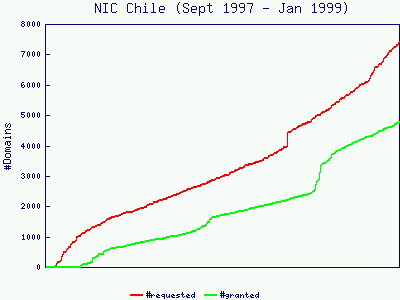
The following graph shows the total accumulated number of applications received and granted from September 1997 until January 1999.

Domain Name Conflict Resolution Under the .CL Top-Level Domain

As the graph shows, we did not enjoy the luxury of starting slowly. On the contrary, the rate of arrival of applications during those first days has yet to be matched. This is clearly an effect of the panic caused among businesses by the attempt to grab a massive number of domains in late August 1997.

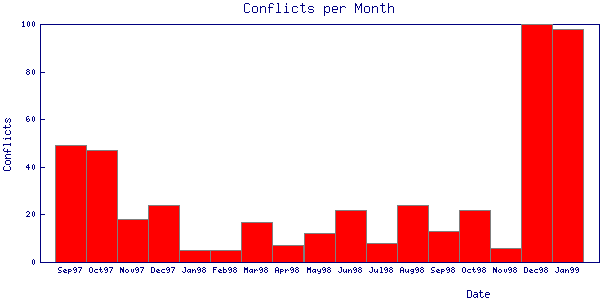
The following graph shows the number of new conflicts for each month. We define a conflict as a domain name requested at the same time by more than one applicant.

Domain Name Conflict Resolution Under the .CL Top-Level Domain

It has been surprising to us that the conflicts that have occurred have been distributed in so irregular a fashion. At first glance, the number of cases of attempted name piracy has been very large, numbering some 500 among approximately 8,000 applications. However, almost all of them have come in “waves” and have been triggered by applications submitted by no more than five different applicants. After the first such wave, which motivated the introduction of the policy, and in which in the course of a few days more than 300 well-known names were requested by just two applicants, there have been two additional cases where applications for a large number of domain names corresponding to well-known brand names were submitted. In all those cases, the applicants did not get the domains they requested, sometimes because they did not pay for them, or because they withdrew their applications after the owners of the respective brand names reacted by submitting their own applications. In exceptional cases, the arbitration process began, but in all of them, the first applicant withdrew the claim at the initial hearing. In only one case did the trademark owner not act within the 30-day period, and the applicant was assigned the domain. In this case, it was only several months later that the trademark owner contacted our NIC to inquire about that particular domain.

In light of the extremely low yield for the would-be pirates, it is surprising that they keep trying. It seems a fact of life that at least twice a year someone will have the bright idea of going through the phone book and requesting all company names that are not yet registered as domain names.

Of all other “normal” conflicts, there have been 19 that have arrived at the arbitration stage. In 14 of those cases, one of the parties has finally withdrawn its application, and in the remaining 5 cases, the arbiter has had to make a decision.

In three cases, instead, one of the parties has gone to the courts to file a suit. Because of the slowness of the Chilean judicial system, all of the parties have taken a speedier route by claiming that their constitutional rights have been violated. This kind of claim has to be resolved very quickly, so it is seen first directly by the Appeals Court and then can be appealed to the Supreme Court.

In one of those cases, the claim was considered moot because the supposed pirate did not comply with the NIC requirements within the 30 days, and the application had already been rejected automatically by the time the court was to hear the case. In the other two cases, the complainants lost, and the courts ruled that the University was under no obligation to run a check on the possible trademark status of the domain names requested. As for any possible trademark infringement, the ruling said that it was not a matter of constitutional rights.

In summary, brand name holders have been very unsuccessful by going to the courts, whereas on the other hand, they have had almost 100% success by following the procedure set by the policy of the NIC.

Problems encountered

In the course of the first year of application of the policy, we encountered a number of minor problems that led to some amendments that were introduced exactly one year from the beginning of its application.

Several of the problems had to do with applicants missing the deadlines for various reasons. Most applicants had no opposition from another party and seemed to be making a good faith effort to comply, but were late nevertheless. In those cases, we started extending the deadlines, but we finally arrived at a situation in which some applicants were many months late and showed no signs of trying to comply.

After giving notice and waiting for an additional period, we had no alternative but to start deleting those domains, and afterwards we established a firm policy of deleting domain name applications as soon as they missed their deadlines. The result has been that a much larger fraction of the applicants have complied, and the rest have had to reapply if they still wanted the domain.

Another source of problems was the documentation we requested to be submitted. At first, we followed the advice of one of our stricter lawyers and required a statement with an original signature, and photocopies of the incorporation papers of the companies and of their ID cards. Not surprisingly, this requirement turned out to be extremely cumbersome, and we later reduced it to a minimum set of documents to be sent by fax instead of by regular mail. As a minimum, we have found that we cannot avoid requiring a signed statement from the applicant, and a copy of the ID document that would allow us to have some evidence that the applicant legally exists and is correctly identified.

Still with this reduced set of documents, we found that in many cases we had to delete applications for which the fee had already been paid, but the corresponding documents had never been submitted. This situation was undesirable, because many applicants felt that because the fee had been paid, we had no right to delete the application. So, to make it increasingly difficult to forget to fax those papers, we decided to require that they be sent before the activation of the domain. Applicants that need to have a domain operating quickly have found that sending a fax is something they can readily do after filling our Web form to request the domain.

The most significant change we had to make was in the arbitration process. When we had to start applying the new policy in a hurry, there was one already existing arbitration panel that was available, well known, and respected by the business community and did not require the signing of any previous agreement between it and the university.

As it turned out, this panel, established and operated by the Santiago Chamber of Commerce, provided a much needed service but had several drawbacks. One was that their arbiters knew very little about the Internet and found it difficult to make decisions on these matters. Another problem was that these disputes did not have a clear monetary value attached to them, so their fee schedules were not applicable. For disputes of indeterminate value, the fees of the arbiters were often very high, and applicants who had to pay them complained about the cost.

Because of these problems, in cooperation with ACHIPI, a new arbitration system was established, in which the panel of arbiters would include people that knew both the Internet and the intellectual property laws and in which the fees would be significantly lower than before. This system has been operating for just a few months, but the initial experience has been very positive.

Future evolution

Although the system has reached a great degree of stability, there are some standing issues that need to be addressed. Our policy provides a way of solving the conflicts that arise during the 30-day publication period, but they have no way of dealing with conflicts that may appear afterwards. The problem is a difficult one, because it might mean taking a name away from someone who has been using it on the Internet for a long time if the opposing party were to succeed in proving that they have a greater right to that name.

For this reason, we have refrained so far from including these among the conflicts that are handled by the arbitration system. However, some cases involve a strong sentiment in favor of allowing the “reopening” of a closed case. Namely, when it can be determined that the first applicant has acted in bad faith (e.g., to prevent the registering of a competitor’s domain).

It is unclear at this stage whether the arbitration process will be extended in this direction, and it is unlikely that it would be extended beyond that. Therefore, it becomes crucial that all interested parties be informed of the applications as they are published, so that they do not lose the opportunity of defending their rights.

Currently, our listing on the Web satisfies this need, and many people have adopted the habit of checking the list periodically. But some steps need to be taken to make this list more visible, and we have started talks with the “Diario Oficial” (the official publication medium for laws and official announcements) to have their Web edition include a link to our page.

However, if we consider the future growth of the number of domain applications, it is quite probable that very soon the publication list will be too large and we will have to add new ways of disseminating this information. One way we may do that is by allowing people to join a notification list and ask them for a list of names about which they might wish to be notified. By using approximate searching, regular expressions, and so forth, we could provide a powerful information system for the community of users of NIC Chile.

A final problem we are facing is the abuse of the information available at our Web site. Some local spamming for advertisement is done by individuals who are using our contact information (available to the public on our Web site) to construct bulk e-mail lists. The difficulty here is that our operation is based on making the contact information public. Perhaps, however, very large queries (such as for lists of all the domains registered) should be forbidden.

Conclusions

Our experience with the application of this policy has proved that a system based on publication of domain name applications, and the use of arbitration to adjudicate domains in the case of disputes is a viable way to run a registry. One of our priorities has been to minimize the problems that this process could cause to the vast majority of applicants, who are not involved in any disputes and only want to have their domain available as soon as possible.

During the operation of the system, a seemingly high number of conflicts appeared (affecting around 5% of the requests). However, most of them never reached the arbitration process, because a request had been withdrawn by one of the applicants. Only a tiny number of requests reached the arbitration stage (around 0.2%). This finding seems to indicate that occurrences of domain name disputes are less frequent than expected, which we believe would also be true at an international level under generic domains.

We have introduced the changes that have seemed necessary to eliminate those aspects of the system that have proved to be unnecessarily complicated or costly. We feel that we are approaching a kind of “steady state” that should make the DNS a stable component for the development of the Internet in Chile.

References

  1. Baeza-Yates, R., Piquer, J.M., and Poblete, P.V., “The Chilean Internet Connection or I Never Promised You a Rose Garden”, INET’93, http://www.nic.cl/inet93/paper.html
  2. Postel, J., RFC 1591: Domain Name System Structure and Delegation, http://www.nic.cl/rfc1591.html

Copyright 1999 José Miguel Piquer, Patricio V. Poblete

Categories
Papers

Comparative Study: School Networks in Latin America

Julián DUNAYEVICH <julian@esc.edu.ar>
Jorge MAYER <jorge@esc.edu.ar>
Romina D’ERAMO <romina@esc.edu.ar>
Red de Escuelas
Argentina

Arnoldo VIDAL M. <avidal@iie.ufro.cl>
Enlaces
Chile

Víctor GUERRA <vguerra@servidor.unam.mx>
Red Escolar
Mexico

Alejandro PISANTY <apisan@servidor.unam.mx>
Universidad Nacional Autónoma de México
Mexico

Abstract

Several Latin American and Caribbean countries have made progress in designing and implementing school network projects at a national level. These projects have been undertaken as part of an educational system modernization process. These ongoing projects are related to new trends in communications and information technology in the field of education.

This paper will analyze the various national experiences. Its main points are the following:

  • Different types and approaches of the several national projects; definition and scope of universe and of basic strategies; goals; adaptation modes between the project and the type of educational system; network extension programs; and interpreting these policies in terms of making up for inequality.
  • Network engineering models; existence or lack of a central backbone; types of telecommunication technologies; supplying equipment; scope of service; and accessibility to rural zones and those difficult to access.
  • Program administration policies; financing; participation of private sector; agencies for project management; management, technical, professional, and educational teams; budget makeup and administration; and studies on the regulatory framework of each country.
  • Pedagogic models; teacher training; developing educational programs; educational TV experiences and multimedia resources; and adapting such resources to classroom and school.
  • Development of national experiences; degree of implementation; evaluation systems used in carrying out and achieving goals; and indicators of the impact of the policies on the educational process and on the region.

Project reports as well as statistical and technical reports will be used for this paper.

Contents

Information and communication technologies in public education policy design

Over the past years there has been a growing trend toward modernizing educational systems. There are various new models for using technological resources in education, known as information and communication technologies (ICTs). ICTs can be found in a large number of different fields of human activity and they have a growing capacity for storing, processing, producing, and transmitting information.

Information generated by the ICTs requires that the educational systems use new knowledge resources and the values that current circumstances require. Thus, criteria may be generated with the purpose of selecting and evaluating such information in terms of effectiveness and relevance, and in addition new ways for bringing about knowledge may be learned.

Within this context one of the main challenges is to carry out the technology use process, while at the same time providing increasing knowledge about, and control over, these technologies.

It is widely known that ICTs allow access to a wealth of information, in addition to offering increasingly sophisticated possibilities for the production of education-related syllabuses and contents. Therefore, investing in the development of these technologies yields results difficult to match by other means. ICTs offer new possibilities to reach distant places or those difficult to access. In addition, these are tools that tend to diminish inequalities stemming from different opportunities to access education, culture, health, and entertainment and thus are extremely valuable.

The following remarks are needed to clarify our starting point. As seen from a macro social level analysis perspective, the expansion processes of these technological resources tend to bring about significant changes in the social structure of most societies. Even though these changes vary in different countries, they have caused a widening gap in social classes, at least in the 80s when new production organization modes generated significant productivity growth for a specific business segment — that of the most up-to-date companies, in terms of new technology use [GIDD1983].

The widening gap came about due to a technology revolution that generated high unemployment rates and a restructuring of the higher productivity sectors within the global economy. Education plans to be implemented should therefore focus on this issue, granting access to education in the use of technology resources. The overall results of this balancing policy should be assessed from a global perspective and in the long term [DHAR1989]. Nowadays the most outstanding political scientists question the fact that the liberal democracies show an unexpected capacity for generating large inequalities within the framework of stable political regimes [HOBB1988].

Thus, the use of ICTs is part of a process and its success is contingent both on how it is implemented and on other goals and values of a social nature that may be desired.

The application of new technologies to education is being carried out in a large number of countries, even in the less developed and very poor ones. The association between ICTs and education is currently well known in different forms: pilot projects, isolated private projects, government policies, and development or educational projects of international organizations.

The aim of this article is to make a comparative analysis of experiences in implementing nationwide school networks in different countries. This may lead to general issues involved in public policy implementation or, if more limited, to issues related to education. We will focus on Argentina, Brazil, Chile, and Mexico.

Differentiating factors in the various projects are of a very elementary nature: number of inhabitants, number of students, geographic distances and social gaps, development center distribution, and access to energy and to basic communication resources.

From an international perspective, we can see numerous ways in which governments involve the private sector in project generation. While in many Latin American countries, it merely acts as a service contractor, in other countries, such as the United Kingdom, the government requires companies to participate in certain ways in exchange for authorizing their participation as providers of new services. It should be pointed out that the more industrialized countries appear to be much stricter in terms and conditions for those private enterprises that wish to participate in these types of policies than the less developed ones. This may point to a trend toward a reversal in the integration mode of the private sector in the context of such policies.

The question that we deem to be key to this article might be the following: Are there common standards for the formulation of projects worldwide, in particular in Latin American and the Caribbean? If so, do these standards seem to meet requirements or principles that appear to be universal?

Information and communication technologies in educational programs in Latin America

The Chilean, Mexican, Brazilian, and Argentine Ministries of Education deemed it necessary to create a system that would enable them to unify and link their countries’ educational institutions.

Therefore, they set up systems to meet their needs and development possibilities, but the four countries took into account that it was essential to bring the ICTs to their teachers and students.

Enlaces (Chile) http://www.enlaces.cl/

The Chilean Ministerio de Educacion (Ministry of Education) through their Programa de la Calidad y Equidad de la Educación (MECE) (Program for Education Quality and Fairness) seeks to introduce improvements and innovations in teaching so as to improve the quality and fairness of the Chilean educational system.

It is the purpose of the Chilean Educational Program Enlaces, ongoing since 1993, to make the technology available to financially aided schools, whether municipal or private, primary or secondary.

Chile plans to have a nationwide network, which is able to grow, but is decentralized. Within this context teachers are perceived as key agents for change together with the technical and training support structure entrusted to universities and higher education institutions.

Enlaces believes the improvement of education quality by using information technology in schools depends on the attitude and on the work of teachers. Hence, teachers who join the project (20 per school) are trained for two years and are given technical support. Free Internet and a variety of educational software is also available to them. They become familiar with the programs so as to be able to apply them to the teaching-learning process.

Enlaces plans to reach 100% of high schools and 50% of elementary schools by the year 2000, which is to say approximately 5,000 subsidized schools. Currently 3,000 elementary schools and high schools have joined the net, thus making up a large virtual community benefiting over 1,400,000 students and over 35,000 teachers. Of the municipal and private schools 95% are subsidized, with the remaining 5% made up of private schools that pay and are in the net with their own resources.

The government is in charge of providing equipment and assisting schools in Enlaces both technically and pedagogically, as well as connecting them to Internet services. Private institutions are given the software and necessary documentation and each one joins the net with their own resources.

The target of Enlaces for the next two years is to allow net primary and secondary schools to form a nationwide school community able to interact regardless of their physical location or sociocultural characteristics.

This net not only supplies the means to include ICTs in the education process but is committed to controlling its use as well. From time to time they evaluate the impact of ICTs on education by means of tests and surveys given to students and teachers. They also supervise technology use, teaching experiences, and administrative use of the tools.

Red Escolar (México) http://redescolar.ilce.edu.mx/

Red Escolar (School Network) is the name given by the Secretaría de Educación Pública de México (Mexican Public Education Secretary) to a project planning to introduce ICTs to education.

This project, which started as a distance learning plan for adults, brings the Internet to every education level classroom with the purpose of making available to students information on different subjects, giving them a different research source and the possibility of expressing themselves.

Through Red Escolar the government provides computers with resources to access the Internet, as well as a variety of school educational software to public elementary schools and teacher training high schools, thus serving their needs.

Red Escolar as well as Chile’s Enlaces aims to decentralize the curricular and administrative network aspects. It furthers the developments of government programs of computer education and is enriched by similar projects created by federal organizations.

The Secretaría de Educación Pública de México (Mexican Public Education Secretary) set guidelines to be followed by the net. The Secretary also encouraged Red Escolar to promote reading and writing skills and math, as well as an interest in research and in team work, to facilitate access to information sources, and to consult directly with specialists, using e-mail and discussion forums.

Red Escolar is aware that teachers may feel confused when confronted with the ICTs and therefore they are offered opportunities for training and professional updating. In general, the net promotes techno-pedagogic teams in each school.

This net offers a teacher training program for a minimum of 10,000 teachers (two per school) and a technical support and maintenance program for schools.

The Red Escolar program expects to provide a Media Classroom with five to ten computers each for 3,000 elementary schools, and 2,000 high schools. In addition they will supply peripherals, special software and CD-ROMs, a TV set, and a VCR.

Red Escolar began its work in 1996. During the first stage, approximately 400 schools, which already had computers, joined. In 1998 the net was made up of 400 primary schools, 600 high schools, and 32 teacher centers, as well as teacher training schools. They estimate that by late 1999 there will be almost 2,000 schools, half of which will be equipped with their own resources while the rest will receive contributions from several organizations.

Proinfo (Brazil) http://www.proinfo.gov.br/

The Secretaria de Educação a Distância del Ministério da Educação (Ministry of Education’s Secretary for Distance Learning) is in charge of implementing the Programa Nacional de Informática na Educação (Proinfo) (Educational Computing National Program). The Brazilian government is planning to introduce ICTs to diminish education opportunity differences among students of public and private schools.

Teachers are trained to know how to apply the technologies to daily tasks, given the fact that studies performed show that 20% of the teachers are skilled and use ICTs, while 20% are unskilled and resistant to using them. The remaining 60% are unaware of what to use them for.

Brazil decided to implement this program in a decentralized manner, so that each state would be able to adapt it to its own characteristics. However, national authorities are pedagogically responsible for Proinfo and are in charge of school equipment for a five-year period. The government approves projects for each state.

In 1998 Proinfo reached close to 6,000 schools (about 8 million students), 13.4% out of a 44,800 public school universe made up of primary and secondary schools, each one attended by over 150 students. Proinfo estimates the minimum hour/student ratio needed and evaluates resources and equipment in relation to fulfill this. This is an uncommon characteristic among the projects reviewed.

RedEs (Argentina) http://www.esc.edu.ar/

The RedEs project is implemented by the Ministerio de Cultura y Educación (MCyE) (Ministry of Culture and Education) with the purpose of improving communication and exchange of information between schools and libraries, as well as national, provincial, and municipal education authorities.

Red de Escuelas will be built on a public utility structure. It will use existing connections of the telecommunication companies and of the Internet providers; but it is also institutional, as the Ministry of Education’s Technical Council, representing all its agencies and programs in agreement with provincial ministries, will determine priorities regarding uses, conditions, and applications.

In five years RedEs will have linked all Argentine schools (44,000). Given the size of the project, the first short-term target in late 1999 will be to link schools that are currently part of Ministry of Culture and Education programs, starting with high schools, rural schools, and the last three elementary school grades. An estimated number of 3,000 schools will have joined RedEs in the course of this period.

The Ministry of Culture and Education through RedEs plans to invest in communication infrastructure, in maintenance, technical support, and dissemination. RedEs will use computers already made available by other programs and projects of the Ministry of Culture and Education, and others to be made available.

RedEs will be built on the basis of existing programs, such as the following, to which its activities will be linked:

  • Red del Plan Social Educativo (Social Education Plan Network), a project that gives access to the Internet to those benefiting from the Plan de Becas (Scholarship Plan).
  • Red Telar (Todos en la Red) (Everyone in the Net), a project that, based in the Red de Escuelas, provides schools with pedagogical content and promotes learning projects carried out by teachers and students.
  • Red Electrónica Federal de Formación Docente Continua (REFFDC; Federal Electronic Network for Continuing Teacher Training) provides distance training to teachers in every school in Argentina.
  • Biblioteca Nacional de Maestros (Teachers’ National Library), is an organization that plans to coordinate and manage a consortium of educational information jointly with Centro Nacional de Información Educativa (National Center of Educational Information). The consortium members are documentation centers, pedagogic libraries, community libraries, and multimedia resource centers at schools.
  • Proyecto de Descentralización y Mejoramiento de la Educación Secundaria (PRODYMES; Project for Decentralizing and Enhancement of Secondary Education), a project that subsidizes 630 secondary schools implementing the education reform with over 250 students and a high quantity of failing students. PRODYMES subsidizes computers, infrastructure, and other goods for these schools.
  • Red Federal de Información Educativa (REDFIED; Federal Educational Information Network). The purpose of this organization is to supply reliable statistics to be used to plan, monitor, and evaluate the educational systems as well as changes in it.

Services included in the projects

Chile

Enlaces is linked by e-mail and education bulletin boards. It uses a technical support and training system made up of high prestige universities. This system, known as Red de Asistencia Técnica de Enlaces (RATE) (Enlaces’ Technical Support Network), provides connectivity and techno-pedagogic support to projects participating in the project. The universities are divided into six Zone Centers (four geographic zones: North, Center, South, and Austral South) and 21 Executive Units.

Enlaces provides the following to public or private subsidized schools: a computer room equipped according to number of students, connectivity, software, and two years of technical support. To ensure optimal use, computer specs are updated every year.

Brazil

Proinfo uses microcomputers, MS-Windows IBM compatible PCs (as used in every government office in Brazil), and a variety of software programs needed for school work, such as word processors, spreadsheets, data bases, and others. Color printers, graphic interfaces, and the hardware and software needed to provide access to the Internet and TV-Escola (the Brazilian TV education system) are included.

Argentina

RedEs plans to test various school-linking technologies during its first year. The fact that new low-cost data transmission services, as well as services unavailable at present due to the regulatory framework may become available, will be taken into account.

Agreements with the telecommunication companies were signed so as to connect the schools. This was done with the purpose of reaching schools more easily, without the need to carry out an initial investment in data network development. Schools will be provided with a telephone line and two daily hours of free phone service to access the Internet. Registration and data network use will be free.

RedEs topology will consist of high-capacity servers supplying: management of network names for schools, receiving and storing e-mails, sending e-mails, chatting, and discussion forums, among other services.

As new developments in the Information and Communication Technologies are very frequent, RedEs assigns part of its resources to research in the new technologies and to the possibilities of using them. They also focus on the relationship with telecommunication companies so as to learn of possibilities of implementing new technologies.

How is a school network financed?

Chile

Chile’s Ministry of Education considers that the private sector will be an essential factor for the Enlaces project to meet the goals set for the end of 1999, demanding an estimated investment of US$120 million.

The most expensive component in Enlaces is hardware (close to 70% of the budget), the service life of which is about five to seven years. This means that many schools will need to upgrade and add to their computing rooms beginning in 2000.

On the other hand, both elementary and secondary schools will have to somehow gradually undertake the expense of their connection to the Internet with increasing bandwidth and accessibility demands. This will involve more telephone lines, higher speeds, improved modems, high-capacity servers, and ultimately, higher costs for educational institutions. This reality and the way it is addressed should be the core of strategy to attract private sector support and participation.

Depending on the laboratory’s dimensions, the costs in Chile amount to US$5,773 for a small lab fitted with three PCs and one printer at schools with less than 100 students. US$9,003 is needed to install six computers and two printers where 100 to 300 children can be instructed, and a large laboratory with nine computers and two printers for over 300 students demands about US$11,980.

Mexico

In a volunteer and shared effort, all community sectors in Mexico — teachers, students, parents, and education authorities — are summoned to support Red Escolar development and maintenance through financial contributions; human resource allocation; and equipment, service, promotion, and training provision and upgrading.

The project expects financing to come through a three-legged participation scheme where the federal government, the provinces, and society will add their contribution. One of the most fundamental bases for the network are universities and other higher education institutions, which provide training, undertake the education of academic leaders, and integrate their students to the social service projects promoted by the network. In any case, IADB and the World Bank have granted the government loans intended to fund the project’s progress.

Estimates for this endeavor have set the demands for a general scheme with minimum infrastructure consisting of one TV set, a VCR, and 5 to 10 PCs at US$17,000. Seventy percent of this investment is supposed to come from the federal government, 20% from the province or municipality, and the school would fund the remaining 10%. The school will also bear the costs of the telephone connection, the space, and furniture of the place where the laboratory will be located.

Brazil

The people in Brazil think that Proinfo effectiveness and continuation will depend on the availability of financial resources. The investment for 1997-1998 was estimated at about US$300 million for training, technical support, purchase of equipment, remodeling of facilities, school networking, and creation of two NTE. The outlay for this investment was made jointly by the Ministry of Education, through its own resources and loans. The provinces contributed 20%, and municipalities and the general public put in the remaining percent.

Argentina

As regards RedEs, in order for a mass action to be undertaken during this first year, agreements were made with the telephone companies for them to subsidize the largest part of communication costs. This would allow a large number of educational institutions to be connected all over the country without the need for a significant initial investment in data network development.

Additionally, schools will be benefited during 1999 with a telephone line installed for free, the subscription fee at the rate of residential subscribers, and two-hour daily use at no charge. The registration fees and use of the data network is also provided for free. In order to ensure the resource availability, it was established that the line installed for RedEs will be used solely for such purpose.

As a long-term success criterion, the network is expected to achieve self-sustainability, along the lines of the decentralization promoted by the education reform. While this will introduce a higher administrative cost to organizations and institutions managing the network, closer control of the services rendered will be attained and a more flexible administration, more closely oriented towards its own objectives, will be possible.

Loans and private sector contributions also have a substantial role in the development of this project.

Conclusions

Technological development and improvement is an extraordinarily dynamic and expansive process rapidly pervading and modifying the customs of the whole society. Information and Communication Technologies (ICTs) are no exception and the level of their improvement demand changes in different areas, particularly in education.

As discussed in this paper, the need to incorporate ICTs has been understood by national authorities in the education area of Argentina, as well as those of Brazil, Chile, and Mexico and now they are all working towards their implementation within the teaching and learning process. The path found to reach such an objective is to apply government policies at the federal level, which also involves programs of extraordinary dimensions within education programs.

ICTs implementation generated curricular changes

The interconnection of computers in a network joining schools opens a number of possibilities worth analyzing.

The use of ICTs as a teaching aid demands a redefinition of the concept itself: the extraordinary availability of information supplies and specific programs that can be used in education poses new challenges to the entire pedagogic model. Education experts have been cautiously addressing this issue for some time already.

From the very moment plans are devised to introduce computers into the classroom or other study environments a fundamental change has to be envisaged, a response has to be thought out involving an all-encompassing modification of the teaching-learning process: from the principles to the methodology. And this is not just about introducing new ways to produce information but to establishing a new teaching method. The issue comes down to finding out to what extent the mere introduction of new teaching aids may be the seed for the change of a pedagogical paradigm.

ICTs as the driver of teachers’ continuous improvement and academic exchange

One of the basic problems posed by this type of policy is that the training schemes projected at the national level demand extraordinary budget allocations. The dynamics of technological advance, in turn, make training in the use of certain tools difficult, time-consuming, and expensive to evaluate. It is clear, on the other hand, that beyond the schemes using multiplying teacher systems, which have an unparalleled effectiveness and economy, there are many other basic issues still to be defined: Is training oriented to teacher learning? If so, is it in order for them to be able to teach the use of such tools? Are they trained in the use of the resource in order to facilitate the performance of basic functions just for the school environment? This makes it necessary to plan how to integrate the problems associated with change for the new roles that technological progress allow to create as well as those related to basic training and continuous re-qualification.

Teachers have to be prepared to get into programs that give them the tools to establish new approaches to classroom work, irrespective of the redefinition such space is undergoing. Teachers must learn how to use the network to teach and they will also learn how to benefit from it in order to acquire new knowledge. ICTs incorporation will probably change the teachers’ role as the main agents of knowledge dissemination. They will then have to start occupying other spaces in a process, which is redefining its functions.

According to the above discussion on the programs themselves, we are in the first generation of training courses where means and technologies go no farther than making teachers familiar with these media and no longer-term objectives can be set as yet.

Networks will be a tool to achieve more homogeneous education plans and offer the same opportunities of study and access to information

All the plans for the union of educational institutions by means of information networks are devised to encompass the whole nation, thus bringing all educational communities in a country closer. Each of those communities, though, has its own peculiarities based, in principle, on the characteristics of the location (whether geographic, cultural, economic, political, and so on) and will bring such features into the network.

Interaction will allow knowing each other, exchange knowledge, and experiences but will also help globalize certain aspects, mainly those associated with education. Being part of the same educational system and united through a network simultaneously offering everybody the same possibilities of development gives everybody the same opportunities to grow. All will have access to information and then it will be up to each party how to capitalize on it.

Networks will make it easier to establish regional educational policies

Restricting our observation to Argentina and the countries surrounding it, they are all developing or projecting their interconnection to an information network.

In light of this situation, policies have to be established to foster cooperation and effective integration within the framework of regional agreements of various scopes. To this direction point the proposals of the Second Summit of the Americas, which included in its work line #8 the integration of ICTs to the education process as one of its basic goals in the cooperation. This can be understood to mean that initiatives will be gradually implemented ranging from technical cooperation for software design and management to interconnection and work for the production of educational software and contents common to the whole region.

Besides, if it was possible to conform an economic block as Mercosur, these other forms of integration can be accomplished too. Given the substantial investment required by these programs, the cooperation between nations is a must: in the form of incentives for regional industries to contribute their supplies, from the need that these policies bear fruit, in the form of research of the evolution of pedagogical models and technical resources. This possibility should not be thought for the long term, as technological development relentlessly evolves, day after day.

Of course, there exist some aspects that should be harmonized, such as the role of governments in the networks. For example, in Chile goods and services are being transferred, while in all the other programs, as their implementation set longer-term landmarks, support and funding commitment proposals have no precise terms. So, they can assume their responsibility in the sustaining of the program even though they might request support from public school cooperation entities, as is the case in Mexico.

In this issue Argentina shows greater flexibility as regards the manners. The government responsibility is basic and sustained but permanent assistance programs are integrated for the purpose of helping needy schools to get on with the project and the improvement and expansion of the services rendered is contemplated through funding the schools themselves can adopt.

Network content: an issue still to be defined

It is true that faults are noted, as regards projects and planning for the production of contents programs in school networks, and, for the time being, there is no consolidated industry producing educational software to satisfy the dimensions and the demand of these projects at all their levels. This is one of the most crucial issues to be solved. Mexico has a tradition and an experience originated from the production of videotapes and TV programs for its educational channels. Chile is attempting to consolidate a most suggesting experience in the universities, while Argentina has been organizing the Argentine Internet Olympic Games, which are just fledging initiatives that nonetheless signal to a trend as regards the creation of incentives for network content development.

References

[GIDD1983] Anthony Giddenns, La Estructura Social Moderna. Ed. Alianza. Madrid. 1983.

[DHAR1989] Ralph Dharendorf. El Conflicto Social Moderno, Ed. Península. Madrid. 1989.

[HOBB1988] Eric Hobbsbaun, Escritos sobre la Modernidad. Universidad de Buenos Aires, Buenos Aires 1988

Copyright 1999 Julián Dunayevich, Arnoldo Vidal M., Víctor Guerra, Alejandro Pisanty

Categories
Papers

Alternative Paths to Internet Infrastructure: The Case of Haiti

Jon M. PEHA <peha@ece.cmu.edu>
Carnegie Mellon University
USA

Abstract

Haiti does not appear to be the most fertile ground for Internet growth. It is a poor nation with low literacy rates, difficult terrain, and few working telephone lines outside the capital city. Despite these impediments, resourceful entrepreneurs have sought to offer and expand Internet services, and have sometimes explored unconventional technical approaches. Haiti now has four commercial Internet service providers (ISPs), and Internet services are available in five Haitian cities. This paper will provide a brief description of today’s Haitian Internet sector. The Haitian experience demonstrates that the shortest path to Internet infrastructure in developing countries may be radically different from the paths taken in wealthier nations. It also shows how policies regarding spectrum management, international telephone service, ISP licensing, and resale can impact Internet growth.

Contents

1. Introduction

If one were searching for a nation that could not support a commercial Internet sector, it would be hard to find a candidate much better than Haiti. A weak economy, widespread illiteracy, difficult geography, and political turmoil all conspire to inhibit Internet growth. Yet, Haiti has celebrated five years of commercial Internet services. Four firms currently compete for a growing customer base.

Haiti is one of many developing countries that have demonstrated that the benefits of the Internet are not limited to the wealthiest nations. While many of those developing countries have pursued a path to Internet development that is similar to that of the wealthiest nations, Haiti’s entrepreneurs have taken a radically different path. They have found ways to leverage their strengths and circumvent their barriers.

This paper provides a brief overview of today’s Haitian Internet sector, focusing on the lessons Haiti can provide on Internet development in developing countries. In the process, this paper will show how Internet telephony complicates Internet development in many countries, and how spectrum management polices play an important role.

Section 2 provides background on telecommunications in Haiti. The Internet Service Providers are described in Section 3. Section 4 discusses the principal policy issues facing Haiti’s Internet development. The paper is concluded in Section 5.

2. Telecommunications climate

As this section will show, there are good reasons why infrastructure development is challenging in Haiti. Autocratic rule and political turmoil have left a difficult legacy. For almost three decades, Francois and Jean Claude Duvalier (father and son) ruled Haiti, and despite the nation’s poverty, these leaders amassed large personal fortunes. The second Duvalier regime collapsed in 1986 after an open revolt. Years of crisis and instability followed. The current democracy was established in late 1994 when Jean-Bertrand Aristide, the elected and deposed leader, returned from exile.

This history has left Haiti among the least developed countries in the hemisphere — a real challenge for infrastructure development. Its per capita gross domestic product is around 250 U.S. dollars. Although there is great need to build the information infrastructure that can facilitate long-term economic growth and political stability, short-term needs like health care are also pressing. For example, roughly one in nine Haitians do not survive to their first birthday. With illiteracy rates exceeding 60%, the number of people who could navigate the Internet is somewhat limited. Finally, the geography itself is not conducive to infrastructure development. As an island nation, it is remote from every country except the Dominican Republic, and mountainous terrain makes domestic interconnection expensive. Costs are further increased because 65% of the population is rural.

Haiti does have one trait that is conducive to telecommunications growth: a large expatriate community living in the United States, Canada, and elsewhere. This trait boosts the demand for international communications services, even among those with relatively low incomes.

Telephone services are provided by Telecommunications d’Haiti (Teleco), a government-owned monopoly. Telephone infrastructure is among the most limited in the world, making a lack of phone lines the preeminent issue in Internet growth. Haiti has 0.9 phone lines for every 100 people — less than half the average for Africa. If one excludes the large capital city of Port au Prince, Haiti has 0.2 telephone lines per 100 people. It often takes years to get a phone line; there is a waiting list of roughly 100,000. Despite some ambitious plans, there has been no significant increase in phone lines for years. Moreover, at any given time, roughly one-third of the nation’s phone lines are out of service. Telephone service costs are roughly 10 U.S. dollars per month.

Despite the limited domestic service, Teleco has remained profitable in most years. Fifty percent of Teleco’s revenues come from international services, which are highly profitable, thanks to high accounting rates. The government receives 25% of Teleco’s revenues, so it depends on the company’s success. Moreover, there is talk of privatization in 1999, which would bring more money to government coffers, particularly if Teleco is profitable. Thus, as in many countries, one cannot address Internet policies without considering the impact on the monopoly telephone provider.

Other telecommunications services are also limited. Teleco does not provide pay phones, nor does it allow resellers to use its phone lines for this purpose. There was an open tender for cellular licenses in 1995, and several companies are developing cellular infrastructure in Haiti, but operation has been repeatedly delayed. The one functioning telecommunications sector that is not controlled by Teleco is Internet.

3. Today’s Internet service providers

There are currently four commercial Internet Service Providers (ISPs) in Haiti, offering services in five cities to between 1,000 and 2,000 customers. (For comparison, there are roughly 40,000 working phone lines). Even with high costs to establish Internet service, the number of customers is growing.

Each of the four commercial Internet Service Providers is unique. They have different histories, objectives, resources, and market niches. Each is responding in a different way to the challenges of the Haitian environment, where the most recurring theme is the weakness of the telephone system. Their varied origins are representative of typical ISPs. Each ISP is described below.

3.1. Hintelfocus: the multinational telecom connection

MCI came to Haiti as a provider of telecommunications services for the U.S. armed forces and the U.S. embassy, without offering commercial services to Haitians. Once a company has established a satellite link for international communications, it is cost-effective to expand the capacity of that link and support other services. Eventually, an ISP called Hintelfocus was born which exploits this resource.

Hintelfocus offers Internet services through its point of presence in Port au Prince, which is collocated with MCI’s international gateway. MCI carries the international traffic over a satellite connection. The connection with MCI gives Hintelfocus easy access to international communications capacity. In addition, although they would probably be more prosperous with additional telephone lines, they have considerably more lines than their competitors. Given their relatively good access to telecommunications capacity on both sides, they provide a typical Internet service based largely on dial-up access over the telephone system.

Hintelfocus prices would be competitive in many countries. There is a $30 set-up fee. Customers requiring access for less than 25 hours per month pay only $10 per month. Other packages are available for heavier users.

3.2. Alpha Communications Network: the Internet founder

Alpha Communications Network (ACN) became Haiti’s first commercial ISP in 1993, and is still Haiti’s largest ISP. ACN’s history and orientation is very different from that of Hintelfocus. The original purpose of the system that has become ACN was to support the internal needs of a large Haitian company. They soon realized that could use the same equipment to provide telecommunications services for other businesses. Many ISPs around the world have similar origins. ACN now has its own international satellite link that it uses to carry Internet traffic and offer virtual private network services for many businesses that have offices in Haiti. As the ISP with the greatest international telecommunications capacity, ACN also provides the underlying communications services for other ISPs.

Although ACN has ample international capacity, it has few local telephone lines. Indeed, its access to telephone lines has actually declined. After accusations were made that ACN was allegedly providing international telephone services in violation of Teleco’s monopoly, Teleco took back two-thirds of ACN’s telephone lines. Although ACN denied the allegations, it still lost the majority of its dial-up customers as a result of the controversy.

ACN has responded to the scarcity of phone lines with an unusual strategy; it has deployed its own wireless infrastructure, circumventing the telephone system completely. Transmitters are installed on the premises of major customers, providing dedicated connections to the ISP. The principal technology is Lucent’s WaveLan, which operates at 2.4 GHz using a spread spectrum to facilitate sharing. Although the WaveLan was developed for very different purposes, it has met the needs of ACN customers. Systems have been modified as needed to address local conditions. ACN has used this approach to serve customers up to 20 km from their point of presence. (This approach has probably reinforced the motivation to focus on customers within the capital city, but ACN has recently begun offering services in a second city.) Clearly, this approach makes spectrum management an important issue for Internet development.

With a business model based on dedicated wireless links, customers can expect good performance, but high initial costs for customer premises equipment, irrespective of monthly service charges. Internet connections to a single computer must cost in the neighborhood of a couple thousand dollars. Customers using their link to connect a bank of computers will pay several times that. Despite these heavy costs, ACN has a waiting list for new customers.

3.3. Companet: the expanding computer vendor

For years, Companet has been a growing vendor for computer equipment in Haiti. They also provide support for their customers. As a result, they already had technical expertise and established relationships with many potential Internet customers. This is another common and excellent springboard to becoming a commercial ISP.

Like ACN, Companet’s access to phone lines for dial-up service is severely limited. They similarly rely heavily on dedicated wireless links using spread spectrum technology, with comparable costs.

Unlike ACN and Hintelfocus, Companet also lacks a license that would give it access to its own international satellite connection. Its application for such a license remains unanswered. Companet survives as an ISP by reselling communications services from ACN. This allows Companet to succeed as an ISP, and allows ACN to expand its market and compete more effectively with Hintelfocus. Resale among competitors is another important and unusual feature of the Haitian Internet sector.

3.4. Globelsud: serving the unserved

Like Companet, Globelsud provides Internet services by reselling the international capacity of ACN. It also uses both phone lines and dedicated spread spectrum wireless links. However, Globelsud differs significantly from Companet and the other providers because it targets a different market niche. Created just one year ago, Haiti’s newest ISP has emphasized serving those who would otherwise be unserved. For example, Globelsud has vigorously promoted the creation of telecenters, where the public can come to use computers that are connected to the Internet. A customer can pay five US dollars to exchange e-mail with a relative living abroad from a telecenter, even if they don’t have a computer or a phone line at home. Frequent users of the telecenters pay $35 to $50 per month.

Globelsud has also focused on providing rural Internet access — an important mission in a country where 65% of the population is rural. While their competitors were still offering services only in Port au Prince, Globelsud was operating in five cities. This would be an impressive accomplishment in any developing country, and is more so in Haiti where 75% of the urban population is in Port au Prince. Globelsud has ambitious aspirations to serve many more secondary cities and rural areas in the future. Among their innovative projects is an effort to teach seniors in a Haitian school how to establish telecenters in rural areas.

To provide services cost-effectively, Globelsud has explored different technologies, and different levels of service. In many cases, they use store-and-forward systems that exchange information over domestic phone lines every hour. This is adequate for e-mail, or for downloading specific information, but is obviously not conducive to interactive Web browsing. Globelsud is also exploring a variety of alternative and innovative wireless technologies to make Internet connections to remote areas more cost-effective.

3.5. Possible future providers

Other Internet providers may be forthcoming. Plans are under way for the launch of a fifth commercial ISP, that would use both phone lines and wireless connections, and that would resell international capacity from either ACN or Hintelfocus. Other providers who do not require telephone lines are likely to begin offering Internet services as well.

The first will probably be the government’s National Bank (Banque de la Republique d’Haiti), which plans to deploy a fiberoptic backbone, connecting to an international gateway. They will advance the nation’s financial infrastructure by supporting banks, insurance companies, stock brokers, and other critical financial institutions. They also hope to include universities and schools. Customers will pay fees for these services, although this is a not-for-profit venture. What is probably most unusual about this state-owned Internet venture is that it is separate from the state-owned telephone company.

If and when the providers of cellular telephone service begin operating, they will also have the capability to bypass the telephone company to reach local customers. As such, they will have strong motivation to become full ISPs, or to make resale agreements with ACN or Hintelfocus.

4. Issues and controversies

4.1. Internet telephony

The government-owned telephone company has a monopoly on the lucrative international telephone services. However, other companies can carry international Internet traffic, and can form virtual private networks by connecting a private local area network (LAN) or private branch exchange (PBX) in Haiti with a LAN or PBX in another country. Of course, the international carrier has no way of knowing when its customers are using this service to support voice communications that might otherwise have taken the form of a long distance phone call. This issue has been so problematic in Haiti that allegations of this practice led to a severe reduction of phone lines available to two of the ISPs (ACN and Companet).

This issue is common to many developing countries, although it is particularly severe in Haiti. Reasons include the heavy dependence on revenue from the telephone monopoly, the potential impending privatization, and the extremely high prices for international telephone calls. Regardless of the Internet, Haiti will eventually have to decrease the price of international calls, and probably increase domestic rates to balance revenues. Such a move will probably be driven by call-back services, which allow calls out of Haiti to be charged as if they were calls into Haiti. International regulatory pressure is also mounting.

Ironically, Haiti’s attempt to protect the telephone company has probably harmed it in the long term. In many countries, Internet growth increases revenues for the telephone company. Calls to ISPs can be extremely long, leading to significant revenues in countries where there is a per-minute charge for local calls. This is especially true in countries like Haiti where long downloads of information from abroad are common. In addition, frequent Internet users often request additional phone lines. If Teleco were allowed to charge more for installing extra phone lines, it could raise significant revenues to expand and improve its infrastructure. However, the existing policy of rationing phone lines to Internet users has further encouraged the best customers for long calls and additional phone lines to bypass the phone company. This could be extremely costly when the inevitable rate changes do occur.

4.2. Spectrum management

Because of the lack of telephone lines, three of the four commercial ISPs rely primarily on wireless technology to reach their customers. Consequently, wireless communications are essential for Internet growth in Haiti. So how should access to the spectrum be regulated? At the moment, no license is required for access, and wireless devices can be placed anywhere, but ISPs are required to pay significant fees back to the regulator. The rights and obligations of these unlicensed users are not entirely clear. The policy has already led to controversy, with allegations that some unlicensed wireless connections interfere with a licensed microwave link. There have been demands that these Internet connections cease operations. Whether the allegations are true or not, this controversy demonstrates the value of clear spectrum management policies to promote Internet growth.

There are many options available to manage such a band [1]. The traditional approach is to require licenses for all transmitters. Applicants for a license specify enough information about intended use that a regulator can prevent excessive interference with any current license-holder. Haiti’s current unlicensed approach has the advantage that the regulator does not add unnecessary delay to the process of Internet expansion. It also makes it possible for ISPs to offer dedicated links to mobile devices, as there is no need for permission from the regulator when a transmitter is moved from one site to another. There are also disadvantages to unlicensed. One is that there is nothing to prevent many businesses from deploying these transmitters in the same location, so there is always risk of congestion. Luckily, in a country like Haiti, this is considerably less likely than it would be in an American city. (Haitian ISPs have made good use of this advantage.) Another problem is that, since spectrum is shared, devices have little incentive to conserve spectrum. This may lead to devices transmitting at excessive powers, or transmitting constantly. Some may even set up transmitters whose sole purpose is to interfere with the transmissions of their competitors. If an unlicensed approach is selected, explicit rules of coexistence can reduce many of these problems [2,3].

4.3. International gateways

Two of the current ISPs can operate international gateways, and the other two cannot, despite applications to the regulator. In many developing countries, there is only one international gateway. The advantage of having more is apparent in Haiti. One ISP voluntarily chooses to provide communications services for some of its ISP competitors. If it refused to do so, customers might be lost to the other facilities-based ISP. The fact that the ISPs have different market niches makes the arrangement more attractive to potential facilities-based competitors. The additional competitors are also good for Haiti, particularly when one of those competitors has targeted customers that might otherwise have been missed.

Although this can benefit the facilities-based provider, it is often to the provider’s advantage to take customers from the resellers when it can. This will inevitably lead to some tension. Disputes may address prices, quality of service, access to equipment, access to IP addresses, or other limited resources. Issues have already arisen, and some believe that the regulator should intervene. These are difficult matters to regulate effectively. This tension will probably continue until more companies gain the right to operate an international gateway (even if they choose not to exercise that right).

4.4. The government as provider

The National Bank’s decision to provide Internet services exemplifies another dilemma that is common in developing countries. The Bank recognizes the need for such a network to strengthen the financial sector, and no commercial ISP has access to the necessary capital. A government can even tap international donor organizations. However, the move may threaten the commercial ISPs by siphoning customers, perhaps with the help of implicit subsidies. Making the enterprise effective and efficient under government control will also be a challenge, as is demonstrated by the experience with the government-owned telephone company. Perhaps this Internet infrastructure will also be privatized some day. It is too early to draw conclusions from Haitian experience in this area.

5. Conclusions

The Haitian experience clearly demonstrates that the Internet can grow even in the least developed countries, when regulators grant commercial ISPs permission to operate and access to critical resources. Four commercial ISPs have emerged, each capitalizing on its own unique experience, resources, and objectives.

More importantly, Haiti has shown that there are many paths to Internet development, and that every country must find the path that best matches its resources and objectives. The Internet began in the Untied States, at a time when telephone lines were in roughly 95% of all homes, the lines were dependable and relatively free of noise, and prices were low with respect to income. Thus, commercial ISPs in the United States relied primarily on dial-up service, and ISPs in many developing countries have emulated this approach. Haiti did not, and with good reason. Haiti has no such telephone system. Resourceful Haitian ISPs have instead adopted wireless technologies as a critical part of Internet infrastructure, even though these wireless devices were clearly designed for other purposes. The ISPs are consuming a resource that is more plentiful in Haiti than in counties like the United States: unused spectrum. They have also demonstrated that low-speed store-and-forward communications and telecenters have particular value in the Haitian context.

The importance of wireless technology to Internet growth makes spectrum management particularly important. Like all developing countries, Haitians have the opportunity to develop spectrum policies that are appropriate to their unique situation, like a greater availability of spectrum. Their current use of unlicensed spectrum demonstrates its vast potential, as well as challenges to overcome if clear and effective coexistence rules are not established.

Like many developing countries, artificially high prices for international telephone service create particular difficulties for Internet growth, as Internet telephony threatens this revenue stream. The growth of wireless alternatives complicates this issue. The artificial prices encourage heavy users to bypass the telephone system; when international telephone rates are reduced, as they inevitably will be, telephone carriers cannot share to the same degree in the increased revenues from Internet expansion. Thus, the presence of wireless Internet access provides additional incentive for regulators to rebalance these rates.

Many developing countries allow only a single entity to operate an international gateway carrying commercial Internet traffic. Some point to economies of scale to justify this arrangement. Haiti has demonstrated the value of having two such gateways, and allowing resale. As a result, four ISPs have emerged that collectively cover a broader range of customers. Still, the resale arrangements are not entirely without tension, because some ISPs offer both wholesale services to resellers and retail services to Internet customers, which always complicates matters. It is possible that easing licensing restrictions on international gateways further will reduce or eliminate these tensions.

References

  1. J. M. Peha, “Spectrum Management Policy Options,” IEEE Communications Surveys, Fourth Quarter 1998.
  2. D. P. Satapathy and J. M. Peha, “Spectrum Sharing Without Licensing: Opportunities and Dangers,” Interconnection and the Internet: Selected Papers From the 1996 Telecommunications Policy Research Conference, Mahwah, NJ: Lawrence Erlbaum Associates, pp. 49-75.
  3. D. P. Satapathy and J. M. Peha, “Etiquette Modifications for Unlicensed Spectrum: Approach and Impact,” Proc. IEEE Vehicular Technology Conference, May 1998, pp. 272-276.

Copyright 1999 Jon M. Peha

Categories
Papers

A Legal Technical Framework for the Online Resolution of Domain Name Disputes

Christopher GIBSON <christopher.gibson@wipo.int>
Jim FULLTON <james.fullton@wipo.int>
World Intellectual Property Organization
Switzerland

Abstract

As Internet technologies and applications evolve, along with emerging e-commerce, the legal issues surrounding the use of intellectual property on the Internet have given rise to complex international disputes. An example of this phenomenon is the increasing number of disputes concerning Internet domain names.

The World Intellectual Property Organization’s (WIPO) Arbitration and Mediation Center is developing an online mechanism for the resolution of Internet domain name disputes. This facility is to be offered in connection with the new international system for the registration of domain. In this connection, the Center has been designated to administer certain procedures for the resolution of disputes arising out of the registration of Internet domain names registered under the new generic top-level domain names covered by the Memorandum of Understanding on the Generic Top-Level Domain Name Space of the Internet Domain Name System (gTLD-MoU).

The envisaged dispute-resolution mechanisms, which aim to avoid the inherent limitations of national judicial remedies in dealing with conflicts of global dimensions, are online Administrative Challenge Panel (ACP) Procedure, a special procedure to be administered by the Center; online WIPO Mediation; and, where mediation was unsuccessful, online WIPO Expedited Arbitration. Thus, a third party considering that its rights are violated by a domain name registration may, without prejudice to any applicable rights to initiate court litigation, call the domain name registrant to any of these procedures.

A groundbreaking feature of the three envisaged mechanisms, and one that may in the future prove useful also for other types of disputes, is their online character. Parties will be able to file requests by completing an electronic form. With the possible exception of original documentary evidence, all submissions may be exchanged online through dedicated lines. In addition, parties and neutrals will be able to communicate simultaneously (an electronic chat facility), reducing the need for time-consuming and expensive in-person hearings.

A major challenge is presented by the development of the technical infrastructure necessary to support the proposed system. Working with external contractors, the Center is developing the software and hardware requirements. The dispute-resolution system will be Web-based, meaning that users may access the procedures through the Internet site of the Center. The site is being redesigned to include such functions as automatic notifications, a password-protected facility for the online exchange of pleadings and real-time communication, an electronic fee payment system, and access to a database of ACP determinations.

The presentation at INET’98 will describe the legal and technical aspects of the WIPO online system, as well as its suitability for other online dispute-resolution procedures. Of course, if necessary, the presentation can be split into two separate presentations, but we believe that a more seamless approach might be quite interesting and innovative and cause the audience to stretch a bit in its knowledge and understanding.

Contents

Introduction

The amount of intellectual input and components subject to intellectual property rights has increased dramatically over the last decade. As Internet technologies and applications evolve, the emergence of electronic commerce, a new means for the use and transfer of intellectual property, has begun to significantly influence the way companies do business. The legal and technical issues surrounding intellectual property on the Internet have proliferated, giving rise to complex disputes. As the current trend continues, the expansion of electronic commerce on the Internet may soon lead parties to prefer to settle disputes arising out of such commerce in the same manner as such commerce is conducted.

The World Intellectual Property Organization’s Arbitration and Mediation Center is developing an online, Internet-based system for administering commercial disputes involving intellectual property. This mechanism is to be made available initially for disputes involving Internet domain names, where an immediate need is expected to arise and certain assumptions can be made about the technical sophistication of the parties. In particular, the WIPO Center’s online facility will be available for disputes arising out of the registration of Internet domain names under two new systems:

  • The international system covered by the “Memorandum of Understanding on the Generic Top-Level Domain Name Space of the Internet Domain Name System” (gTLD-MoU), which was signed on May 1, 1997 and creates a plan for seven new generic top-level domains; and
  • The INternet ONE system, a domain name system operated by a newly established nonprofit entity in which domain names are to be registered in a shared indexing system.

While the Center plans to make its online dispute-resolution services for these domain name systems available in the first quarter of 1998, it is envisaged that the Center’s online facility will be available in mid-1998 for other types of commercial disputes.

Online administration of disputes

A novel feature of WIPO’s new dispute-resolution mechanisms is their online character. Parties will use digital communications to the maximum extent possible in the dispute-settlement procedures. They will be able to file requests by completing an electronic form. With the exception of original documentary evidence, all submissions may be exchanged online through secure channels. In addition, parties and neutrals will be able to communicate simultaneously (using electronic “chat” as well as, when available, audio and televideo facilities), thereby reducing the need for other potentially time-consuming and expensive means of communication and in-person meetings and hearings. It is expected that the online mechanism will also increase speed in the procedures while reducing costs, so that parties will prefer this alternative “forum” for its overall efficiency.

The development of the technical infrastructure necessary to support the proposed system has presented a major challenge for the Center. The system is intended to be Internet-based, meaning that users may access the procedures through the Internet site of the WIPO Center. The site is currently being redesigned to include such functions as forms for filing cases, automatic notifications, an electronic fee system, secure facilities for the online exchange of documents, links to real-time communication tools, and back-end databases to support the proper logging and archiving of documents and transactions.

The legal infrastructure also needed to be drafted, to establish separate versions of WIPO’s standard rules to accommodate the online character of the proceedings. While the existing WIPO rules will remain in effect, the Center has been engaged in an effort to produce adapted versions of these rules, as well as draft new ACP Rules for the administrative procedure supporting the gTLD-MoU system discussed below.

Dispute resolution for domain names in the gTLD-MoU system

WIPO has been designated to administer dispute-resolution procedures for the new gTLD-MoU system. The planned dispute-resolution alternatives, which aim to avoid the inherent limitations of national judicial remedies in dealing with conflicts of international dimension, are as follows:

  • The online Administrative Challenge Panel (ACP) Procedure, an administrative procedure addressing only the parties’ rights with respect to a domain name and excluding any possibility of obtaining monetary relief (other than the costs of the proceeding).
  • Online WIPO Mediation
  • Where mediation is unsuccessful and the registrant has not opted out, online WIPO Expedited Arbitration

A third party considering that its rights are violated by a domain name registration may, without prejudice to any applicable rights to initiate court litigation, require the domain name registrant (who is bound by virtue of the registration terms and conditions) to submit to any of these procedures.

The ACP procedure, in particular, is an administrative function designed to focus efficiently on one critical issue: which party has superior rights with respect to a particular domain name. A key document drafted by the Policy Oversight Committee, the governing committee for the gTLD-MoU system, the Substantive Guidelines Concerning Administrative Domain Name Challenge Panels, so restricts the jurisdiction of the ACP panels and introduces several novel remedies and substantive provisions. The Guidelines include suggested criteria for the ACP panels to apply in resolving disputes and create an “exclusion,” so that a party with significant intellectual property rights in a given name may, rather than registering its domain name in all gTLDs, register only in the gTLD that is relevant to its business purposes and seek to exclude others from creating confusion by improperly registering its name in other existing and future gTLDs.

Disputes, of course, will not be decided by the WIPO Center itself, but by the ACP panelist(s), mediator(s), or arbitrator(s) that will be constituted in accordance with WIPO procedures and on the basis of the WIPO List of Neutrals. Any decision resulting from these procedures will be directly implemented by the Council of Registrars (CORE) for the new system, by making appropriate changes in the CORE database. Thus, there is a built-in enforcement mechanism.

Dispute resolution for domain names in the INternet ONE system

WIPO has also been designated to administer dispute-resolution procedures for the new INternet ONE domain name system. The INternet ONE system seeks to facilitate users’ access to domain names by creating a shared domain name depository, enabling entities with identical names to co-exist on the Internet. When matching domain names have been registered by two or more parties, a “distinguishing information page” will appear, listing not only the domain name for each entity, but also providing associated text identifying and describing each party as well as hypertext links to their own Internet sites.

Unless a third party chooses litigation, online WIPO Expedited Arbitration procedures, tailored for the INternet ONE system, will be applied in case such a dispute arises. The dispute-resolution mechanism will be restricted to the issues of rights with respect to the domain name and the corresponding listing information. A decision resulting from these procedures will be implemented directly by INternet ONE.

Training sessions

The WIPO Center is planning a series of one-day training programs to examine implications concerning dispute resolution in the online context. The objective of the programs is to train neutrals on WIPO’s list both in the use of the legal procedures and in the online tools that will be an essential part of the new procedures. The sessions will also explore, in particular, new techniques that may be applied to facilitate settlement procedures given that communications may take place primarily through the online medium. Those individuals interested in participating in these training sessions should contact the Center.

The online dispute-resolution system

WIPO has taken the approach of being able to quickly respond to organizational needs for Web-based, online dispute-resolution services. The Center develops customized dispute-resolution packages based on two internally developed systems; the first of which can be customized and put online within a matter of days, followed with a more powerful, high-volume system which is tailored to the needs of the organization based on feedback from users of the initial system.

In general, both systems support the secure filing of electronic documents and correspondence into a docket. These documents and correspondence are date and time stamped and are made available simultaneously to all parties (including the neutral) in the dispute. Similarly, parties to a dispute can exchange secure, confidential correspondence through an internal mechanism. When documents or correspondence is added to the docket, all parties are notified by a preferred mechanism (usually electronic mail). Similarly, recipients are notified when private correspondence is entered into the system. All notifications are of a general nature that simply informs the recipient that new information is available for a given case.

From an administrative perspective, the Center can perform many operations needed to ensure the smooth, timely progression of a dispute-resolution activity. For example, the process of selection of neutrals by the parties can occur in a completely online fashion, as can the addition of neutrals or panels of neutrals to a case. The collection and administration of fees associated with the arbitration and mediation process is automated and can be performed in a completely online environment through the use of credit cards and deposit accounts.

Security is provided through flexible methods based on the needs of the users. Digital certificates are supported, as are more traditional username/password mechanisms.

Further information

Further information about the WIPO Arbitration and Mediation Center can be found at http://www.wipo.int. For information about the gTLD-MoU system, see its Internet site at http://www.gtld-mou.org. Information on the INternet ONE system may be found at http://www.io.io.

Copyright 1998 Christopher Gibson, Jim Fullton

Categories
Papers

Regional Integration of Central American Countries and Opportunities for Internetworking

Jorge D. Calvo-Drago <jcalvo@sicanet.org.sv>
Central American Integration System
El Salvador

Abstract

The Central American countries (Guatemala, El Salvador, Honduras, Nicaragua, Costa Rica, Panama, and Belize) have recently decided to go into a process of political, economic, social, cultural, and ecological integration through a Central American Integration System. Some of the challenges that the integration faces include the strengthening of the decision making process, and this paper particularly discusses decision follow-up and coordination, national implementation of regional agreements, social communication and participation of civil society, and external and cooperation relations and their respective opportunities for Internetworking.

Contents

Introduction

The Central American sub-region is composed of seven small and developing countries with a population of almost 32 million inhabitants and an area of 522,008 km2. There were social and political conflicts in some countries during the past decade that left an estimate of 250,000 people dead or missing as well as millions of dollars in losses or damage to the economy.

CENTRAL AMERICA BASIC FIGURES

COUNTRY

AREA
(km2)

Population
(millions)

Literacy Rate
(%)

Life
Expectancy
(Years)

Income per Capita
(US$)

Belize

22,965

.211

93

68

2,450

Costa Rica

51,100

3.011

93

76

2,150

El Salvador

20,749

5.384

78

68

1,320

Guatemala

108,889

10.322

60

65

1,100

Honduras

112,088

5.770

73

68

600

Nicaragua

130,700

4.401

74

66

340

Panama

75,517

2.563

88

73

2,600

The social and political confrontation gave rise to a process of dialogue and negotiation, that ended up in Guatemala last December with a peace agreement between the government and guerrilla groups.

From then on, the challenge to transform Central America into a modern and open sub-region depends on how a democratic culture, a transformation of the productive apparatus, and a modernization of the state are implemented in order to face globalization and to prevent conflict and promote security.

One important aspect in Central America is a process of integration aimed to complement the individual efforts. Such a process is the dream of a “bigger country” for many Central Americans.

The process of integration is not actually new in Central America. A common market was promoted by five out of the seven countries (Guatemala, El Salvador, Honduras, Nicaragua, and Costa Rica) that provided several trade benefits. The new integration process, which not only involves trade but is also political, social, cultural, and ecological, was launched at the beginning of this decade.

This paper attempts to examine the possibilities that Internetworking provides to the integration process of small and developing countries and some of the aspects of the political decision making process in which it is useful.

The Central American Integration System

The Central American Integration System (SICA) was created by the Protocol of Tegucigalpa which was signed by the Summit of Central American Presidents (including Panama and Belize as observer) in that city (capital of Honduras) in December, 1991. The Protocol came into force in February, 1993 and has been ratified by all member States.

The SICA as a system approach has the long term objective of transforming Central America in a Region of Peace, Liberty, Democracy, and Development, and is composed of elements such as intergovernmental decision making bodies, community organs, and specialized agencies.

The main intergovernmental decision making bodies are the Summit of Presidents (the Prime Minister of Belize is an observer) and the Council of Ministers. The latter includes Councils of Ministers of many branches (economy and trade, education, housing and human settlements, health, public infrastructure and transportation, etc.) and is coordinated by the Council of Ministers of Foreign Affairs. Other bodies, include the Forum of Vice-Presidents, the Executive Committee, and a Consultative Committee. The latter is the body that allows participation of civil society in the process and is composed of 20 organizations that represent business, labor, academic, cooperative, peasant, indigenous, and women sectors, totaling approximately 14 million direct affiliates.

Important decisions have been made regarding sustainable integral development, such as the Central American Alliance for Sustainable Development (ALIDES) that not only sees the ecological aspect, but also simultaneously considers economic and social growth. A Treaty on Democratic Security was adopted recently which states that security is an integral part of development and takes the human being as the center, and agreements on freedom of mobilization of people through the borders, and unification of trade barriers, have also been reached.

The regional decision making process has been criticized because of the large number of mandates and the inability of following up and national implementation on the part of the governments, which leads to the second area. The integration process can not go further until the governments implement the sub-regional decisions at an operational level. That means that every sub-regional mandate has six or seven implementations. Currently there is no coordination between the regional and the national level.

The Summit of Masaya, Nicaragua, in 1994, adopted ALIDES as a regional and national strategy for development, and created a regional council as well as national councils for sustainable development, in an attempt to coordinate the regional with the national. The alliance also calls upon the participation of the civil society.

The community organs of the Integration System are the Central American Parliament, the Central American Court of Justice and the General Secretariat of the Integration System (SG-SICA). Also included are Technical Secretariats for the Economic Integration (Permanent Secretariat of the Treaty of Economic Integration-SIECA), Social Integration (Secretariat for Social Integration-SISCA), Cultural Integration (Coordination for Educational and Cultural Integration-CECC), and Ecological (Commission for Environment and Development-CCAD).

The SICA specialized agencies are close to 15 and most of them were born under the Common Market model of the 1960s. A few of them were created during the 1940s and 1950s. A few ones were more recently created during the 1980s and 1990s. Those agencies specialize in matters such as monetary, development bank, health and nutrition, telecommunications, public administration, air navigation, industrial technology, potable water, zoo sanitation, etc.

The General Secretariat of SICA (SG-SICA) is also a creation of the Protocol of Tegucigalpa, with the Secretary-General the top officer of the integration, appointed for a period of four years by the Summit of Presidents. The main functions of the General Secretariat are among others, the follow-up of the decisions of the Summit of Presidents and the coordination of the secretariats and agencies.

In order to carry out its functions, the General Secretariat has developed mechanisms of coordination such as the Commission of Secretariats and the Executive Meeting, which discuss strategies, make recommendations to the bodies, and report on the execution of mandates.

The General Secretariat has a Division of Information Systems and Networking which has responsibilities such as central strategic planning and coordination of information resources and services. The Division also prepares the agenda and presides over the meeting of information officers and specialists of the secretariats and agencies.

One of the main achievements of the General Secretariat was the planning and deployment of the SICA Information Services Network (SICANet) in 1994. This network started to provide services through ALL-IN-1 and X.25 at a time when there was no full Internet presence in all Central American countries. The ALL-IN-1/X.25 platform provided a centralized groupware environment that was able to provide connectivity to secretariats and agencies spread through all the Central American cities.

TCP/IP has been recently added to the platform of SICANet. Thus, the concept of SICANet is now that of a decentralized and distributed environment, and conversely the General Secretariat has plans for building or helping to build such an environment for the secretariats and agencies as well as the above-mentioned organizations of the civil society.

The challenges of the Central American Integration System and the role of Internetworking

The challenges of the Central American Integration are those of building integration simultaneously with an insertion into a global economy. The Central American countries, after suffering from political and social instability, have to face the challenges of building democracy, participation, modernization of the economy, etc. The integration process, conversely, constitutes a favorable regional space to promote and help the individual country efforts to achieve these goals.

The decision making process at the regional level is the centerpiece of the Integration System. Thus the General Secretariat has identified strategic objectives and work areas, closely related to such a decision making process. Those are as follows:

  1. decision follow-up and coordination,
  2. implementation of sub-regional decisions at a national level,
  3. communication and participation of the civil society in the integration process, and
  4. external and cooperation relations

Decision follow-up and coordination

Decision follow-up and coordination are crucial to the existence of the Integration System. The Summit of Presidents actually met for the first time in 1986 and decided to promote peace and an end to internal conflicts. One important decision was to formalize the meetings. From then on, the Summit has met 18 times ordinarily and several times extraordinarily. Three generations of Presidents have continued to meet and make decisions not only in the political, as at the beginning, but also in the economic, social, cultural, and ecological arenas.

The follow-up and coordination suggest the promotion and/or strengthening of human networking. Networking is, very generally speaking, the sharing of resources and/or information related to common goals and objectives. To identify and promote networking by area and decision at the regional and national levels is fundamental to that end.

The follow-up and coordination also bring room for modernization or reengineering of the regional apparatus (secretariats and agencies), and opportunities for Internetworking.

Some characteristics of the SICA secretariats and agencies that constitute clear opportunities for internetworking are as follows:

CHARACTERISTICIT OPPORTUNITIES
created before the system (especially during the sixties within the common market)modernization and reengineering
good links with the governments because they act as technical support in their decision making processgeneration of specialized information and knowledge for the decision making
offices geographically spread among the countriesdistributed environment for groupware and remote access to specialized databases
set of good technical people with master or doctoral degrees in several specialties and field experienceknowledge working
heterogeneity in size, management styles, and resourceshuman networking

The technological support for the follow-up and coordination includes the presidential decision database at a regional level, specialized databases from the more than 20 secretariats and agencies, electronic mail, discussion lists, the World Wide Web (WWW), etc.

In order to accomplish this, the General Secretariat has planned and received funding to execute a project aimed to provide Internet connectivity and training for several dozen executives and officers from the secretariats and agencies members of SICA. The project also funds micro-projects for development and/or reengineering of specialized databases.

National implementation of regional agreements

The implementation of the sub-regional decisions in the national levels means an overlap between national and regional agendas. The member States often and easily reach consensus on a set of regional decisions, but are not necessarily aware of the overlap with their national agenda.

All national agencies from the different countries have their own national agenda and budget, and the ones that carry out the implementation of regional compromises do not have additional resources to do so; therefore an overload of their capacities results.

The monitoring of the implementation of regional agreements has to be able to detect the overloads and bottlenecks of the process, and also be able to alert the decision making bodies to allocate adequate resources.

In that regard, the identification of existing human networks and the promotion of new ones that probably are working with no information technology would be crucial to overcome the bottlenecks and make adequate allocation of resources.

The technological support will consist of a database with national follow-up and monitoring along with connectivity resources and training for those regional networks identified as priority. That would create the adequate environment for communication among public officers from both the national and the regional levels responsible for the implementation of the regional agenda.

Social communication and participation of the civil society

The Summit of Central American Presidents has stated the need of spreading the word on the integration process, so that the people can realize business, professional, and other opportunities. Different social sectors, organized or not, are interested in the integration as they perceive either political or economic benefits or both. Some sectors perceive cultural, social, and ecological benefits as well.

The integration process provides at least a scenario of political spaces for different business, labor, academic, women, etc., sectors to extend their demands from the national to the regional level and strengthen their national agenda from the regional one. One fact is the number and multiplicity of umbrella regional organization members of the Consultative Committee.

Another scenario suggests a more active participation of the organizations of civil society in the decision making process. This scenario assumes decision makers are conscious of the fact that all governmental or inter-governmental actions are directed towards civil society and therefore, that the feedback from it would be a more rational approach to decision making. On the other hand, it also assumes a civil society with very high negotiation skills and capable of reaching consensus among a very wide range of interests.

Some of the technological support includes Internet connectivity, with such tools as electronic mail, Listserv, WWW, etc. Such a support allows, first, communication between the regional offices and the national chapters and also between the latter and their grassroots organizations; second, communication among the regional offices, national chapters, and even grassroots organizations from the different sectors; third, communication between the civil society and the decision making structures and agencies.

The General Secretariat has planned and is currently executing a project to build Internet capacity for the regional offices of the civil society. This capacity includes provision of technology, connectivity and training to the leaders. The project is expected to conduct pilot tests of communication with the regional secretariats and institutions and access to the regional agenda.

External relations and cooperation

The external relations and cooperation with developed countries are very important to complement the efforts of the Central American countries. Such importance is highlighted by, among other aspects, the space that cooperation occupies in the agenda of the decision making bodies and the amount of resources mobilized toward the sub-region.

The resources from external cooperation for Central America are continually decreasing as the peace process has been concluding. A much larger flow of resources was received when the Central America political violence of the 1980s was in the international public opinion. Though the ideological source of the conflict is largely over, the social roots of the violence are now even farther from a solution. This means that, as peace is achieved, the flow of external cooperation should at least be maintained if not increased for a reasonable time, in order to help Central Americans to achieve sustainable and integral development.

It is understandable that the international cooperation agenda has moved to Eastern Europe and other regions in conflict. That fact calls upon Central America to rationalize the increasingly scarce resources received from the international cooperation.

In order to rationalize the cooperation resources, it is important to set priorities, identify duplication of efforts, evaluate the impact of projects, etc., and also, and probably more importantly, to change the model of cooperation. The current model is a one-to-one (donor agency/executing agency) due to the priorities of the donor vs. the priorities of the executor, which makes a project the transforming unit of reality. Another approach should make the problem to solve be the driving unit of reality and a many-to-many model (network of donors/network of executing agencies to solve it).

Hence, the opportunities for Internetworking to share information between the cooperation organizations or development agencies and executing agencies are obvious. Access to databases of resources and projects or profiles also presents opportunities. Currently there is discussion on mechanisms to rationalize cooperation and resources in Central America, and opportunities for identifying and promoting Internetworking.

Summary

CHALLENGE

ASPECT

TECHNOLOGICAL SUPPORT

Decision Follow-up and CoordinationDecision Making Regional Body/Secretariat/Agency Communication, Secretariat/
Agency Networking, Secretariat/Agency Reengineering
Presidential Decision Database, Specialized Databases, E-mail, Listserv, WWW, Video-conferencing, etc.
National Implementation of Regional AgreementsRegional Secretariat or Agency/National Agency NetworkingNational Follow-up Database, e-mail, Listserv, WWW, Video-conferencing, etc.
Social Communication and Civil Society ParticipationRegional Office/National Chapter/Grassroots Communication and Consensus, Regional Office Networking, Access to Regional AgendaE-mail, Listserv, WWW, Video-conferencing, etc.
External and Cooperation RelationsDonor/Executing Agency Networking, Access to Resources and ProjectsE-mail, Listserv, WWW, Video-conferencing, etc.

Note: The viewpoints expressed in this paper are the entire responsibility of the author and do not necessarily express those of the Central American Integration System.

Copyright 1997 Jorge D. Calvo-Drago

Categories
Papers

Domain Names and Trademarks: At the Intersection

Jessie N. Marshall
Administrator for Trademark Identifications, Classification, and Practice
U.S. Patent and Trademark Office
Washington, DC 20231

Introduction

A trademark, as defined by the Trademark Act of 1946, as amended (15 U.S.C. 1051 et seq.) (also knows as the Lanham Act), is either a word, phrase, symbol or design, or combination of words, phrases, symbols or designs, which identifies and distinguishes the source of the goods or services of one party from those of others. A service mark is the same as a trademark except that it identifies and distinguishes the source of a service rather than a product. Most activities on the Internet are considered services by the U.S. Patent and Trademark Office (USPTO), therefore, this paper will use the term service mark or, simply, mark throughout.

Applying for registration in the U.S.

Having defined a service mark, what does it do and how is it treated by the USPTO. A service mark user has rights in that mark as soon as it is used in a service mark manner. Usually, those rights are limited to the geographic area in which the mark has actually been used and can only be enforced against people who may have started using a similar mark after that first user. While these rights are defensible in court, it is much more efficient and powerful to rely on a federal registration for that mark if one can be obtained. And how can one be obtained?

A U.S. service mark registration can be obtained by filing an application form with the USPTO accompanied by a filing fee, a drawing page and, if required, specimens showing how the mark is used in commerce. The USPTO gets its jurisdiction to perform its registration function from the commerce clause of the U.S. Constitution, so marks that are presented for registration in the USPTO can only be registered upon a showing that the mark is being used in a type of commerce that Congress can regulate. For a domestic U.S. applicant, this usually means that the mark must move across state lines in association with the service that it identifies. Movement between only two states is enough to satisfy this requirement. Foreign applicants, that is, applicants that are domiciled in a country other than the U.S., can file and register a mark in the USPTO without a showing of use in commerce by basing their U.S. application on an application or registration in their home country, provided that their home country is involved in a treaty with the United States that grants U.S. reciprocal rights in the other country. There are many such treaties in existence and a vast majority of countries have this treaty relationship. Of course, if a foreign applicant meet the requirements of use in commerce, it may apply based on that use as well. But back to the U.S. applicant and the use requirement.

Before the Trademark Law Revision Act of 1988, a U.S. applicant had to actually be using the mark in commerce before it could apply to register its mark in the USPTO. Beginning in November, 1989, as a result of the Revision Act, a U.S. applicant could apply to register its mark in the USPTO based on a bona fide intention to use the mark in commerce. The mark could not actually register until the applicant showed that it had made such use, but that showing could be made at a later time. A great advantage of using this “intent-to-use” provision was that the filing date of the application would become the effective use date of the mark if the application was successfully matured into a registration. This first use date becomes critical later in this discussion.

Examination by the USPTO

Once an application is received in the USPTO, it is assigned to an Examining Attorney for a review of the legal sufficiency of the application and the mark under the Trademark Act. The Examining Attorney reviews many points in the application, but the following are the most critical.

Statutory refusals

There are a number of grounds on which an Examining Attorney in the USPTO can refuse registration of a mark presented in a service mark application. A few of these issues can result in the application failing to register regardless of what the applicant may do to try to overcome these refusals.

The USPTO will not register marks that “consist of or comprise immoral, deceptive, or scandalous matter; or matter which may disparage or falsely suggest a connection with persons, living or dead, institutions, beliefs or national symbols, or bring them into contempt or disrepute.” 15 U.S.C. 1052(a) A refusal based on this section can only be over come if the applicant convinces the Examining Attorney that the mark is not immoral, deceptive, scandalous or disparaging. This refusal is subject to the prevailing moral standards of the country and USPTO officials. Marks that were refused registration under this section fifty years ago might not be so refused today. Whatever the prevailing moral atmosphere, it would be applied no differently to domain name service mark applications.

Neither will the USPTO register a mark that consists or comprises the flag or coat or arms or other insignia of the United States, or of any State or municipality, or of any foreign nation, or any simulation thereof.” 15 U.S.C. 1052(b) This section should not have a significant effect on people interested in registering their domain name with the USPTO since it is generally limited to graphic representations of a flag, coat of arms or other insignia.

The USPTO will not register a mark that “consists or comprises a name, portrait, or signature identifying a particular living individual except by his written consent or the name, signature, or portrait of a deceased President of the United States during the life of his widow, if any, except by the written consent of the widow.” 15 U.S.C. 1052(c) This section may be overcome by obtaining the consents referred to in the section itself.

Perhaps the most significant statutory refusal is the one that specifies that the USPTO will not register a mark that “consists of or comprises a mark which so resembles a mark registered in the Patent and Trademark Office . . . as to be likely, when used on or in connection with the goods of the applicant, to cause confusion, or to cause mistake or deceive.” 15 U.S.C. 1052(d) Note that this section requires that the likelihood of confusion between two similar marks must be determined in light of the goods (or services) identified by the mark. Thus, the USPTO will register the mark DOMINO for two different entities when one is using the mark to identify pizza and the other is using the mark to identify sugar. An applicant can overcome this refusal by arguing that there would be no confusion because the marks are dissimilar or the goods and/or services identified by the marks are not related to each other. The applicant could also buy the mark and registration from the registrant.

The USPTO will not register a mark which (1) when used on or in connection with the goods of the applicant is merely descriptive of them or deceptively misdescriptive of them (e.g., the USPTO will refuse the mark SCREENWIPE for cloths used to clean computer screens), (2) when used on or in connection with the goods of the applicant is primarily geographically descriptive of them or deceptively misdescriptive of them (e.g. the USPTO will refuse that mark DENVER for western-style shirts originating in Denver), (3) when used on or in connection with the goods of the applicant is primarily geographically deceptively misdescriptive of them (this section is a result of the NAFTA treaty and, while similar to (2), there is a significant difference between them set forth in 15 U.S.C. 1051(f) that is explained below), or (4) is primarily merely a surname (the USPTO will refuse MCDONALD used in connection with anything) 15 U.S.C. 1052(e). The reason for these refusals is that certain words should be left in the public domain for use by all. Any producer of cloths used to clean screens should be able to refer to them as “screenwipes” without infringing someone else’s trademark; anyone who makes western-style shirts in Denver, Colorado should be able to use the term “Denver” in reference to those shirts; and anyone with the surname “McDonald” should be able to identify their own goods or services with their own name.

Of course, McDonald’s is registered for restaurants, hamburger sandwiches and a myriad of other goods and services and all of them are held by a single registrant. This brings us to 15 U.S.C. 1052(f) which allows for registration of marks that have been refused [except those refused under 15 U.S.C. 1052 (a), (b), (c), or (e)(3)] if they have become distinctive of the applicant’s goods in commerce. This means that the applicant can show that the public recognizes these terms not just as descriptive, geographically descriptive or as a surname, but also as a word, symbol, etc. that identifies and distinguishes the source of the goods or services of one party from those of others. This public recognition is known as a showing of distinctiveness in the USPTO. At the very least, if an applicant claims that the mark has become distinctive of applicants goods and supports that claim with a showing that it has used the mark in association with the goods for the past five years, then the registration may be granted if there are no other unresolved issues. As indicated above, marks that have been refused based on NAFTA provisions [15 U.S.C. 1052(e)(3)], as well as those that are refused under various other sections of the Act, cannot invoke the benefit of this provision.

There is also the possibility of registering marks that have been refused under Section 2 (e)(1),(2) or (4) of the Trademark Act on the Supplemental Register. Marks that are capable of distinguishing applicant’s goods or services from those of others but that have not yet become distinctive under the requirements of Section 2(f) (see above) can be registered on the Supplemental Register. A mark that is registered on the Supplemental Register can be the basis of a suit brought in federal court and it can be cited by the USPTO as a possible bar to the later registration of a similar mark used in connection with similar goods or services. A Supplemental registration can be used as the basis of a foreign filing under one of the treaties referred to above and the owner of such a registration can put the US trademark registration symbol on its packaging or advertising. However, there are a number of benefits that a mark that is registered on the Supplemental Register does not have that are present for marks registered on the Principal Register. Probably the most important right missing in a Supplemental registration is that it does not establish the registrant’s exclusive right to use of the mark in the way a Principal registration. This may become significant when analyzing competing rights involving domain names and trademark/service mark registrations.

Finally, the USPTO will not register as a trademark or service mark a term that is found to be generic for the goods or services listed in the application. Such matter simply does not function as a trademark or service mark and cannot be registered under any circumstances because it does not fit the statutory definition of a trademark or service mark. No one may have rights in generic terminology alone.

Statutory requirements

There are a number of requirements that must be satisfied before an application is approved by the USPTO Examining Attorneys. However, unlike statutory refusals discussed above, statutory requirements may be corrected by merely complying with the requirements of the Trademark Act, if possible. For individuals seeking to register domain names with the USPTO the following requirements are the most significant.

The application for trademark registration requires that the applicant indicate the goods or services in connection with which the mark is being used. The USPTO requires that this description be clear and specific so that people who are not necessarily experts in that particular field of goods or services will understand the scope of protection of the mark in the registration. Once the goods or services are adequately identified, they are assigned a numerical classification. The system used in the USPTO is taken from the International (Nice) Agreement. This is an international agreement that sets out 34 classes of goods and 8 classes of services. All of the countries that adhere to this agreement (and many countries that are not adherents but are users of the system) organize their trademark offices according to this classification system. For example, in the area of goods, Class 1 is for chemicals, Class 2 is for paints, Class 3 is for cosmetics and pharmaceuticals and so on through Class 34 which covers tobacco products. In the area of services, Class 35 covers business-related services, Class 36 covers financial services and so on through Class 42 which is a class for miscellaneous services and very often will be used for generalized computer-related services. To satisfy this requirement, the applicant must define and classify its goods and/or services as suggested by the USPTO so long as any suggestions are accurate in reflecting the true nature of the goods or services to be covered by the application.

The second issue that becomes extremely significant to those who seek to register their domain names with the USPTO really combines two inseparable requirements. As indicated above, a trademark application must include a drawing page. The term “drawing” is used very loosely in the USPTO. Merely presenting typed words on the drawing page is perfectly acceptable. However, that “drawing” page is mandatory whether the mark consists of words only, design only or words and design. The mark that is shown on the drawing page is the mark that will appear on the registration certificate, should it issue. Also, as indicated above, the applicant must claim use of the mark in commerce and provide specimens showing how the mark is presented to the relevant public. The mark as shown on these specimens must agree with the mark as presented on the drawing page.

Generally, a drawing cannot be changed if the change would materially alter the mark that was originally presented. A material alteration is considered one that would require the Examining Attorney to perform a new search for possibly confusingly similar prior registrations or that would give a different commercial impression to prospective purchasers. Such changes are not allowed because business people rely on information about pending applications in the USPTO and significant business decisions are made based on that information. The public would not be served if the USPTO allowed a mark such as WIDGET to be changed to FIDGET WIDGET. Perhaps someone had decided to go forward with the mark FIDGET based on the fact that there were no similar marks pending or registered in the USPTO only to find out that the mark it had hoped to register had been added to a prior-filed mark after the FIDGET company applied for its own registration.

Application of statutory refusals and requirements to domain name service mark applications

Statutory refusals in domain name service mark applications

Generally, the USPTO has tried to apply traditional trademark law to the examination of domain name service mark applications. Concerning the first three possible grounds for statutory refusals (immoral, scandalous or disparaging matter; flag, coat of arms or other insignia of a country; name or depiction of individual without consent or of a deceased U.S. president without his widow’s consent), traditional trademark law can be applied with very few variations or problems. In fact, the very significant likelihood of confusion statutory refusal is also easily applied. There are, however, some conceptual problems in considering the statutory refusal grounds of descriptiveness, geographic descriptiveness or deceptive misdescriptiveness, and surnames.

When a second level domain name is applied for with some or all of the leading computer protocol indicators or with a first level domain name, the Examining Attorney must determine the weight to give those elements under Section 2(e) of the Act, 15 U.S.C. 1052(e) (i.e., descriptive, geographic, surname significance). The USPTO has tried to adapt its well-established practice in the registration of 800 telephone numbers to the area of domain names. If an applicant applies to register a mark which consists of a merely descriptive or generic term with numerals in the form of a telephone number, for example 800 or 900 followed by a word, the Examining Attorney will refuse registration on the grounds that the matter presented for registration is describes the service being offered by means of that telephone number. If the word portion of the telephone number is merely descriptive and not generic, the mark may be registered on the Principal Register with a proper showing of distinctive. If the word portion of the telephone number is generic, the mark is unregistrable. The same would hold true for domain names. If the second level domain name is generic for the activity offered at that web site, the mark is unregistrable. If the second level domain name is descriptive, the mark may be registered with a showing of distinctiveness. If the second level domain name is arbitrary or merely suggestive of the activity offered at the web site, the name may be registered as a service mark without a showing of distinctiveness.

Statutory requirements in domain name service mark applications

Identification and classification of services identified by domain names

There has been a great deal of controversy about the identification of services rendered on the Internet and the classification of those services. This controversy is international in scope. In the fall of this year, there will be a meeting in Geneva, Switzerland at the World Intellectual Property Organization, the U.N. agency that administers the International (Nice) Agreement to discuss and harmonize the classification practice regarding these services and any goods that may relate to them. Until that time, however, the United States has had to develop a policy to follow in this area since we have received so many applications that must be dealt with before that international meeting. The USPTO policy is set forth in a position paper that can be found at our Web site (www.uspto.gov). It is entitled “Classification of Computer Services and Associated Policy.” Rather than go into that degree of detail here, that document is appended to this paper. Domain names may be used to identify some of the services discussed in that policy statement.

Use of domain names in specimens to support service mark registration

Domain names are often used like telephone numbers and addresses. They are often printed in small letters on business letterhead stationery, business cards or advertisements in the same way addresses and telephone numbers are presented. In their purest form they provide information as to how to contact the entity, rather than as identifiers of a service. Specimens of this type will be refused in the USPTO because they do not show service mark use of the matter presented for registration. The more distinctive the presentation of the domain name, the further it is physically removed from other merely informational data on the specimens; the more it will be perceived by the USPTO as functioning as a service mark and not just as contact information for a particular entity. The domain name must be used as a source identifier and not just as an entity locator.

Some uses that may qualify as good service mark use of domain names include hard copy advertisements for a web site in which the significant portion of the domain name has been highlighted or set off in some other visual way. Also, on the web site itself, the domain name used as a banner headline or magazine masthead would probably be seen as functioning as a service mark. To provide these computer-generated specimens to the USPTO, the applicant may either take a picture of the computer screen that shows the mark or print out the screen itself.

Agreement of domain name as presented in drawing and specimens

Perhaps the domain name applicant has presented perfectly good service mark use of its domain name. Now the Examining Attorney in the USPTO must look at the drawing that was submitted with the original application. Does the drawing include the computer protocols? The www portion? The .com portion? If so, does the specimen submitted match that drawing presentation? If it does not, can the drawing be changed to coincide with the presentation of the domain name/service mark on the specimens?

The problem the USPTO must solve now is whether the addition (or deletion for that matter) of the computer protocols from a drawing is (1) necessary when the specimens show the mark as actually used in a form different from the drawing or (2) permissible without violating the prohibition against allowing material alterations. If an applicant applies for the second level portion of its domain name, would the USPTO find that the mark differs so substantially from specimens showing the entire domain name that the specimen must be found to be unacceptable? Or will this specimen support the use of the second level domain name and any portion of the rest of the domain name as the mark presented for registration? If the USPTO were to find that the extraction of a portion of the domain name results in an impermissible mutilation of the mark as presented in the specimens, will we allow the applicant to add the missing portions or will we disallow those additions as a material alteration from the mark as originally filed? These questions are as yet unanswered. Most of the domain name service mark applications filed in the USPTO were based on the intent-to-use provisions of the Trademark Act, therefore, they did not have specimens of use filed with the original applications. As these specimens come into the USPTO we will be in a better position to develop a policy in this area.

Relevance of U.S. service mark registrations to NSI domain name dispute policy

With the implementation of the Network Solutions, Inc. (NSI) Domain Dispute Resolution Policy Statement, the number of applications for domain names in the USPTO has greatly increased since the Policy Statement refers specifically to the benefits arising from having a registered trademark or service mark. However, the ambiguities and problems that have arisen with the policy and how it effects or is effected by trademark or service mark registrations are many. The USPTO has very few answers to these questions, but what follows is a sampling of inquiries that have been received concerning this issue. Where there is an answer, it will be presented; where no answer has been formulated, that will be indicated as well. (All domain names are hypothetical–if they actually exist, this paper does not intend to refer to the real domain name. Some questions were taken from actually inquiries made to the USPTO. While any specifying material has been sanitized, much of the wording of the original questions have been left in tact.)

Scenario 1

Question: A small company is being threatened with suit because they have the domain name of XYZ.COM. XYZ is the abbreviation for the small company. They write software that translates Nuclear Image data from one manufacturers format to another manufacturers format. They are threatened by a large company called XYZ (which makes goods that are rather different than the software made by the small company) with many $s and the small company can afford neither the time nor money to take on the large company.

They have been using Internet and the name for two and half years–long before the Internet went commercial and have never received any misdirected e-mail or queries dealing with the goods made by the large company. The question is–Is there any organization in the government or private domain that provides assistance to small companies or individuals (Davids) to fight Goliath; how is it that the big company can force the Internet provider to stop providing service to the small company before the case is litigated? What real basis does the big company have to claim Trademark infringement?

Answer: Unfortunately there is no specific organization that can help–either public or private. However, many attorneys do take on pro bono cases (means “for good”–they do it to help out and don’t charge much if anything–this is a rather hot topic in the law and someone may be willing to take it on for the experience). This information can be obtained from a local bar association. Also, law schools often provide advice and, depending on the legal practice laws of the state, the law students can provide legal representation on a limited scale. Check with any law schools near-by to see if they have such a program. They, too, would charge little or no fee for these services.

There could be an infringement problem. This area is still very vague and is evolving with each new problem that comes up. Private trademark counsel should be sought–sometimes an attorney will take on a case like this just to have a chance to fight the Goliaths of the world.

Scenario 2

Question: A business owns ABC.COM for its domain. It is both a reseller of computer memory and a manufacturer of computer memory. A large toy manufacturer makes a card game called ABC and that is trademarked so they claim to have the rights to the domain.

Answer: The inquirer asked for an opinion on this question. The USPTO is not permitted to provide opinions and the person advised that this situation had to be resolved between the parties. However, this is the classic case contemplated by the Domain Name Dispute Policy.

Scenario 3

Question: How far (geographically) does trademark protection extend? Is it effective world wide or just by country?

Answer: A trademark registration is only good in the country in which it is registered. The new European Community mark is a little different, but a mark from that office would be valid only within the community countries. There is no true international protection. It has to be done country by country although the World Intellectual Property Organization in Geneva makes it easy to file in a number of countries. Still, registration and protection depends on individual countries.

Scenario 4

Question: A law firm has had the domain name XXLAW.COM for almost two years. It just become aware of another law firm with the domain name XLAW.COM and there has already been at least one instance of actual confusion, which has lead to consider registration of our domain name. The XLAW.COM domain was registered in February, 1996.

Would the USPTO view XLAW.COM as descriptive? If not, what sort of specimens would be acceptable. The USPTO policy statement at its web site states that letterheads and cards are not acceptable. What about screen shots that would show the URL? The law firm also put the domain name and URL in printed memos discussing Internet-related legal issues.

The firm specializes in xylophone law; thus, we adopted the XLAW.COM domain because it describes what we do and seemed easy to remember.

The law firm indicated that it understood that any guidance provided by the USPTO is not binding on the USPTO and that an examiner or reviewing authority might take a contrary view.

Answer: (Most of these issues were discussed above.)
The USPTO is analogizing domain names with 800 telephone numbers. If XLAW is not considered descriptive of xylophone law (a recognized shortened form), the XLAW.COM domain name could be registrable. However, registering with our office may not help with confusion on the Internet with XXLAW.COM. The USPTO would probably find a likelihood of confusion between XXLAW.COM and XLAW.COM.

Scenario 5

Question: It seems that “he who has the most money wins” in this area of domain names and trademarks.

This individual has paid lots of money to secure a number of names (i.e. SMITH.COM) which it intends to use merely as an e-mail address site (i.e. john@smith.com for persons wishing to have an e-mail address behind a site name that is recognizable to some as the rock group Smith.

The question is can SMITH.COM be registered as a trademark for use as an e-mail registration site? The site would contain nothing at all about well known Mr. Smith or his rock group. Can a surname be registered as a trademark? Before spending $250 per trademark x 100 names, could this situation be made a bit clearer. After applying and paying, if the trademark is not granted, the money is not refunded, right?

Other questions come to mind about this subject. What if you are Sinbad the comic and you wanted the name SINBAD.COM and someone else to promote the message that sin is bad and wanted the name to be short and easy to remember so it’s called “sin bad” (SINBAD.COM) Who has the right?

According to the Domain Name Dispute Policy even if someone else was the first one to get the name from them, as long as Sinbad has a registration on his name he could get the domain name put on hold or could the first domain name registrant get SINBAD.COM. registered as a trademark because it created a whole new phrase?

If someone lived on 1234 Frank Sinatra Drive in Palm Springs, California, would Frank Sinatra have the right to prevent him from publishing that address? After all, is not “Drive” an extension of Frank Sinatra and the protocol for numbers in front of the name, the same as http://www.franksinatra.com or john@franksinatra.com?

Answer: (Once again, much of this requires legal advice, but some answers are possible. And, once again, much of this information was discussed above.)

A surname can be registered as a trademark if the applicant can prove to the PTO that the public recognizes the term not only as a surname but also as the identifier of the source of particular goods or services. This is done by offering evidence of advertising that promotes the term in connection with the goods or services and other similar material. In trademarks, we determine likelihood of confusion based on both the mark and the goods or services identified in the application. Therefor, in your Sinbad example it is possible that Sinbad for comic books and Sinbad for an organization the promotes moral behavior could co-exist on the trademark register. However, InterNIC is not controlled by trademark law or concepts. The subject matter of the site is not taken into account.

The analogy between the street address and the domain name or e-mail address is an interesting one. However, the USPTO would not register a street address as a trademark or service mark unless it was used as one. As discussed above, the same applies to domain names and even e-mail addresses. As far as a street address being the name of a famous person, if the street address (used as a mark) is not intended and, in fact, does not create an impression that the famous person is affiliated with the goods or services offered under the mark, it might be able to be registered in the USPTO without a refusal by an Examining Attorney and without a challenge by the famous person.

Scenario 6

Question: A business has a mark that is registered on the Supplemental Register. It is a combination of words and design elements. The word is pretty clearly generic and that’s why it’s on the Supplemental Register to begin with. Now there is a domain name that uses that generic term. The trademark registration owner wants to stop it. Can it do that?

Answer: Even though a registration is on the Supplemental Register, it is still a federal registration. There are some limits to the scope of protection that may be provided by a Supplemental registration, but registration on the Supplemental Register is not to be taken as an admission by the registrant that the mark has failed to become distinctive of the goods or services listed in the registration. However, it may serve to put the domain name on hold under the Domain Name Dispute Regulations.

It is unclear how this situation would come out in court. Both sides have valid arguments. On the side of the domain name registrant, the term in question is generic and no one should have any proprietary rights in a generic term. On the side of the U.S. trademark registrant, the registration is valid and they have superior rights in the words and designs as they are used in the registration and, on the strength of the registration, can keep other entities from using the words and designs in precisely the same manner as the trademark owner has used them in its registration. Clearly, the weakest part of the registration is the generic wording, yet, it is still part of the registration.

Conclusion

The USPTO doesn’t particularly need additional trademark and service mark applications to keep it busy–it received over 170,000 applications last year alone. But if, after this presentation, domain name holders feel that their name may qualify for service mark registration, the USPTO is ready to examine their applications. Application forms may be found at the USPTO web site (http://www.uspto.gov). They are contained within the document “Basic Facts About Registering a Trademark”. Visit the site and download the forms. The USPTO will help as much as it is permitted by law.

Trademarks have been around since early humans put ownership brands on livestock and clay pots. Domain names have been around for a few decades at the most. Each one serves different purposes but there is certainly an area where those purposes overlap. It is doubtful whether the rules in that area will ever become crystal clear. There will always be unanswerable questions and questionable answers. But over time, the intersection will become clearer, more questions will have answers and more answers will become (relatively) unequivocal.

Registration of domain names and classification of computer activities in the U.S. Trademark Office

(originally presented on the USPTO web site at http://www.uspto.gov)

Registration of domain names

With the recent publication of the Network Solutions, Inc. (NSI) Domain Dispute Resolution Policy Statement, the number of applications for domain names in the USPTO has greatly increased since the Policy Statement refers specifically to the benefits arising from having a registered trademark or service mark. The PTO is developing policy for handling this new breed of mark. Information concerning the present state of this policy may be helpful for applicants filing in this field. A discussion of this topic must begin with the PTO policy concerning a related field–telecommunications.

The telecommunications field grew rapidly during the last two decades. In 1974, the Office registered less than 100 marks in Class 38, the telecommunications class. With the organizational and technological revolution in the telecommunication industry, trademark registrations in Class 38 mushroomed to over 800 per year in 1992. However, it became apparant that some entities that had been filing in Class 38 did not provide telecommunications services as contemplated by Class 38 of the International Nice Agreement. These entities were applying for services in that class because the service activity was being rendered via telephone. To sort out this problem, the Office developed the “link provider/content provider” policy.

Applicants who merely transport their services over telecommunications facilities (e.g., “providing interactive voice response consumer lending services for credit unions”) should not be considered as rendering a service in Class 38. A service in Class 38 provides the technical link by which “persons”, used in its broadest sense, can communicate. Such a service provider would be considered the “link provider”. However, a service which offers “content” and that is incidentally provided by means of this telecommunications link is in the class it would be in were the content not provided by electronic means. Generally, these “content-provider” services disseminate information and, like other information services, should be classified in the class of the information provided. Appropriate language for such a service would be: “financial information services provided by telephone” (Class 36). Variations on the language are acceptable; however, the ID must first indicate the field of information provided since this will control classification and then the applicant may indicate the electronic or telecommunications means by which the information is transmitted. If the applicant provides information in a very wide variety of fields, the ID should indicate that and the service would be classified in Class 42.

Then we began seeing applications for publications appearing on computers through services such as America Online, CompuServe, and Prodigy, as well as through sites on publicly accessible computer networks. After much controversy, it was decided that these publications could not be considered goods in Class 9 or Class 16 since they were not in tangible form when delivered to the end user from the provider. Therefore, this activity was considered a service. The service being provided is the making available of magazines, books and other publication via computer in that it makes the receipt of these publications convenient and flexible for computer users. Appropriate language for these services would be “computer services, namely, providing on-line [indicate specific nature of publication] in the field of [indicate subject matter of publication]” in Class 42. Thus, a mark such as GQ.COM for GQ magazine made available via computer would be identified as “computer services, namely, providing on-line magazines in the field of fashion, entertainment, health, lifestyle and other topics of general interest.”

However, there was a missing link–the access provider; the services such as America Online, CompuServe, and Prodigy. These entities generally do not provide the Class 38-type telecommunications service for their users. They may provide content, but we have dealt with that issue above. Their primary activity would be perceived as providing the computer access to get from your home PC to the sites of the content providers. Therefore, the Office developed the following ID for this specialized activity: providing multiple-user access to a global computer information network and we classified it as a computer service in Class 42.

It was really a relatively small step to go from the on-line magazines to the World Wide Web sites and their domain names. In a sense, these terms are throw backs to our very earliest attempt to sort out services rendered by electronic means. Our approach has been that the “content provider” or web site owner is providing information by electronic means, specifically, by means of a global computer information network. Therefore, the service of providing the information offered at the web site is an information service that should be classified in the class of the information; business information in Class 35, financial information in Class 36, building construction, repair or maintenance information in Class 37, telecommunication information in Class 38, transportation and storage information in Class 39, material treatment information in Class 40, education and entertainment information in Class 41 and everything else in Class 42. As with the on-line magazines, if the web site offers a wide variety of information, from stock quotations to hot vacation spots to profiles of celebrity life styles, this type of general information service would be classified in Class 42. This scheme complies with the classification of information services under the International Nice Agreement. Of course, all of these identifications should be qualified with the indication that these information services are rendered by means of a global computer network or similar terminology.

It is also important to keep in mind web sites that advertise and sell the goods or services of the site owner. This type of activity would not be recognized as a service under the Lanham Act if not rendered by computer, so it can’t be treated as one when it is rendered by computer. However, the PTO should be able to accept a very low threshold of value-added activity on such sites to qualify them as information services. For example, a specialty food producer may advertise and offer its products for sale on its web site. That in itself would not allow for registration of the domain name for the site as a service mark. However, if the site also included recipes, the history of some of the products and other similar non-commercial information, the domain name could be accepted as the identifier of an information service in the field of food and food preparation rendered by means of a global computer information network in Class 42.

We have come to realize that the most difficult part of registering these domain names will be providing acceptable evidence of use of the mark presented for registration. Analogies have been made with the treatment of 800 telephone number registrations and tradenames. Most applicants have been applying for marks in the form of XYZ.COM and the PTO is treating the .COM portion of the mark like the 800 part of telephone number applications. That portion of the mark has no trademark significance and, so long as it is connected by the period to an arbitrary or suggestive term, it will not effect the registrability of the mark as a whole. Possibly, the addition of the other computer protocol insignia, such as the “http://www.” portion of the mark, would have the same non-effect. However, if the term that carries the trademark significance of the mark; that is the term other than the computer protocol portions of the mark, has a descriptive meaning in relation to the services identified in the application, the entire mark will be denied under Section 2(e)(1) of the Lanham Act as being descriptive.

The more difficult problem in this area seems to be crystallizing into a specimen issue. At this point, most of these applications in the PTO are based on an intent-to-use the mark in commerce, therefore, very few specimens exist on which to base a policy. However, use of these marks can be seen outside of the narrow confines of a trademark application and there are some serious problems in this area.

Generally, domain names are used like telephone numbers and addresses. They are usually printed in small letters on business letterhead stationery, business cards or advertisements in the same way addresses and telephone numbers are presented. They provide information as to how to contact the entity, rather than as identifiers of a service. Specimens of this type will have to be refused as not showing service mark use of the matter presented for registration. By analogy with tradenames, the more distinctive the presentation of the domain name, the further it is physically removed from other merely informational data on the specimens; the more it will be perceived by the Office as functioning as a service mark and not just as contact information for a particular entity.

Some uses that have been encountered outside of the PTO include magazines advertisements for the web site in which the significant portion of the domain name has been highlighted or set off in some other visual way. Yet, the rest of the domain name protocols are presented with that portion. If the applicant has applied for only the highlighted portion of this domain name, would we have to find that the mark differs so substantially from the specimen that the specimen must be found to be unacceptable? Or will this specimen support the use of any portion of the domain name as the mark presented for registration? If the Office were to find that the extraction of a portion of the domain name results in a mutilation of the mark as presented in the specimens, will we allow the applicant to add the missing portions or will we disallow those additions as a material alteration from the mark as originally filed? These questions are as yet unanswered in the PTO and we will have to wait until use specimens begin to come in for these marks before we can clearly answer them.

Finally, a factor that is out of the control of the PTO but that must be kept in mind is the Policy Statement from NSI. Exactly what was meant in the Policy Statement by the reference to a registered trademark or service mark? Must it be registration of the entire domain name, including all computer protocol notations? Is the registration of the XYZ.COM portion of the domain name adequate to take the action allowed for in the Statement? Must the registration be for the exact term that is in controversy as a NSI domain name registration? To refer to a well-publicized situation, would a PTO registration for MCDONALDS be able to be presented in a dispute with the domain name registration MCDONALD? And finally, is any attention paid in the dispute to the goods or services set forth in the PTO registration. Would a PTO registration for athletic shoes have any effect on an NSI registration for the same term for a web site providing information about business opportunities in Greece? These questions, too, must be answered, and their answers may have an effect on what the PTO will accept in the registration of domain names.

Classification of computer services and associated policy

Class 9: Pre-recorded software in hard form (CD-ROMs, diskettes, magnetic tapes, etc.) are in this class with an indication of the subject matter or function of the software. The subject or function must be detailed and specific. Very broad statements of function such as “computer programs for business use” are not acceptable. Of course, computer hardware is in this class.

However, software that is down-loadable from a computer network is considered a service since there are no hard goods received from the supplier. The service is providing the software on a global computer network. Subject matter or function of the software must be indicated, but the service of providing it is in Class 42. An acceptable ID in this area would be “providing computer software [indicate specific subject or function] that may be downloaded from a global computer network.” The same of specificity of subject matter or function is required in this situation as is required for the hard goods in Class 9.

Class 16: As with software in Class 9, only hard copy is considered Class 16 goods. Magazines or books that are downloadable from a computer network are not hard goods and are not classified in Class 16. Publications that are down-loadable or viewable by means of a computer network is considered a service since there are no hard goods received from the supplier. The service is providing the publications on a global computer network. Subject matter of the publications must be indicated, but the service of providing it is in Class 42. (See Class 42 discussion below.) This topic is also discussed in the Examination Note of June 19, 1995 which may be found in the Notices section of the FolioViews ID Manual on PTONET.

Classes 35, 36, 37, 39, 40, and 41: Any activity consisting of a service that ordinarily falls in these classes (e.g. computer games, various financial transactions), and that happens to be provided by means of a global computer network, is classified in the class where the underlying service is classified. For example, banking services are in Class 36 whether provided in a bank or on-line by means of a global computer network. Similarly, the service of providing information by means of a global computer network is classified in the class of the information subject. Entities who offer these services by computer are considered “content providers”, that is, they provide the informational or substantive content of a web site and/or home page. If an entity provides information in a wide variety of fields, this must be reflected in the identification and the service may be classified in Class 42 (e.g., providing information in a wide variety of fields by means of a global computer information network.)

These rules also apply to activities in Classes 38 and 42, however, the comments below also apply to Classes 38 and 42.

Class 38: Provision of telecommunications connections to a global computer network. These services are purely telecommunications connections such as those provided by AT&T, MCI or other telecommunications providers. It is ONLY the technical means by which one computer can communicate with another. It is NOT providing the computer technology that transfers the data; it is the means by which that data is transferred. This service connects the user to the “link provider” (see Class 42 discussion below) or the web site itself.

Class 42: Providing multiple-user access to a global computer information network for the transfer and dissemination of a wide range of information.

Leasing or providing access time to computer databases/web sites/home pages of others in the field(s) of [indicate specific field(s) or subject matter ] by means of a global computer network.

This language covers those services provided by entities such as America Online, Prodigy and CompuServe. They provide the computer connection (often using the telecommunications services of other entities as described above in Class 38) that enable a computer user to access the databases and home pages of others. These entities are considered “link providers” in that they provide the computer connection needed for a computer user to access a content provider. The word “access” should be limited to these services and should not be used in describing the service of a content provider.

A single entity may provide one or a number of the services described above. However, each service must be properly identified and classified even though they may be provided by a one applicant.

If an entire magazine or other publication is presented at a web site, the computer service of providing that publication electronically is considered the primary service involved in this activity. The service being provided is the making available of magazines, books and other publication via computer in that it makes the receipt of these publications convenient and flexible for computer users. Appropriate language for these services would be “computer services, namely, providing on-line [indicate specific nature of publication] in the field of [indicate subject matter of publication]” in Class 42. As with Class 16 publications, the subject matter of the publication does not effect the classification of this service.

General comments:

There are distinct and significant differences among the services offered by the telecommunications connection providers, the “link” providers and the “content” providers. The identification of the services should accurately reflect activity offered by the applicant. Unfortunately, this accuracy depends in large part on the manner in which the service activity is expressed, so great care should be taken that language that describes a “link” provider activity should not be used to describe the services of a “content” provider.

The term “Internet” is still the subject of a proceeding at the Trademark Trial and Appeal Board. Therefor, this term should not be used in identifying any goods or services connected with this global computer information network. Language such as “global computer information network” or a substantive equivalent should be used instead of the term “Internet.”

The same is true of the phrase “World Wide Web”, although the controversy has not ripened into a TTAB proceeding. There are conflicting applications involving the phrase, therefor, it should be avoided in identifications of goods or services. Phrases such as “web sites,” “web pages,” “home pages,” or “global computer information network sites” may be used instead of “World Wide Web.”

The term “multimedia” merely describes how an activity or goods are presented in their electronic form. It is not specific in itself to identify goods or services. Thus “software in the field of multimedia” is unacceptable in Class 9 to describe recorded software and “multimedia information services provided by means of a global computer network” is too vague to identify a service activity.

Copyright 1996 Jessie N. Marshall

Categories
Papers

REUNA: How an Academic Network can be Self-Funded

“REUNA is … a consortia of 19 public and semi-private universities and Chile’s National Sciences Council (CONICYT) that operates and manages Chile’s main access to the Internet.”

Categories
Papers

Development of WWW Services in Mexico, Toward a National Information Infrastructure

“1994 was a year of fast growth in the number of nodes of the Mexican Internet. Its popularity and demand have increased dramatically since the appearance of the World Wide Web (W3) browser ‘Mosaic’.”

Categories
Papers

Networking In Latin America and the Caribbean and the OAS/RedHUCyT Project

“RedHUCyT’s main objective is to connect the member countries to Internet, by integrating an electronic network for the exchange of specialized information among different academic and scientific institutions …”